- SEO for Restaurants: Best Guide to Rank Near Me
- How “Near Me” Search Actually Works
- Google Business Profile Optimization for Restaurants
- Is Your Google Business Profile Costing You Customers?
- Local SEO Fundamentals for Restaurants
- SEO for Restaurants Websites
- Is Your Menu Page Invisible to Google?
- Online Reviews and Their Role in Ranking
- Restaurant SEO Keywords that Matter
- Restaurant SEO Strategy by Season
- SEO for Multi-Location Restaurants
- Restaurant SEO vs. Relying on Delivery Apps
- How Long Does Restaurant SEO Takes?
- Building a Restaurant SEO Strategy
- Ready to Become the Default Choice Nearby?
- FAQs – seo for restaurants
SEO for Restaurants: Best Guide to Rank Near Me
SEO for Restaurants starts with your Google Business Profile, reviews, and menu page working together to show up in “near me” searches — Top Branding Altimeter breaks down the full local strategy here.
Your business name can play a major part in your ability to rank in Google search results. Understanding seo for restaurants is an important step if you’re starting a brand from scratch or even rebranding.
Having a keyword in your brand’s name is one of the strongest optimization methods to get high visibility in the local pack or Google Maps results.
For example, if you own a sushi restaurant, then using targeted keywords such as “sushi restaurants” or “sushi place” is a strong strategy to gain ranking when people search “sushi restaurants near me”.
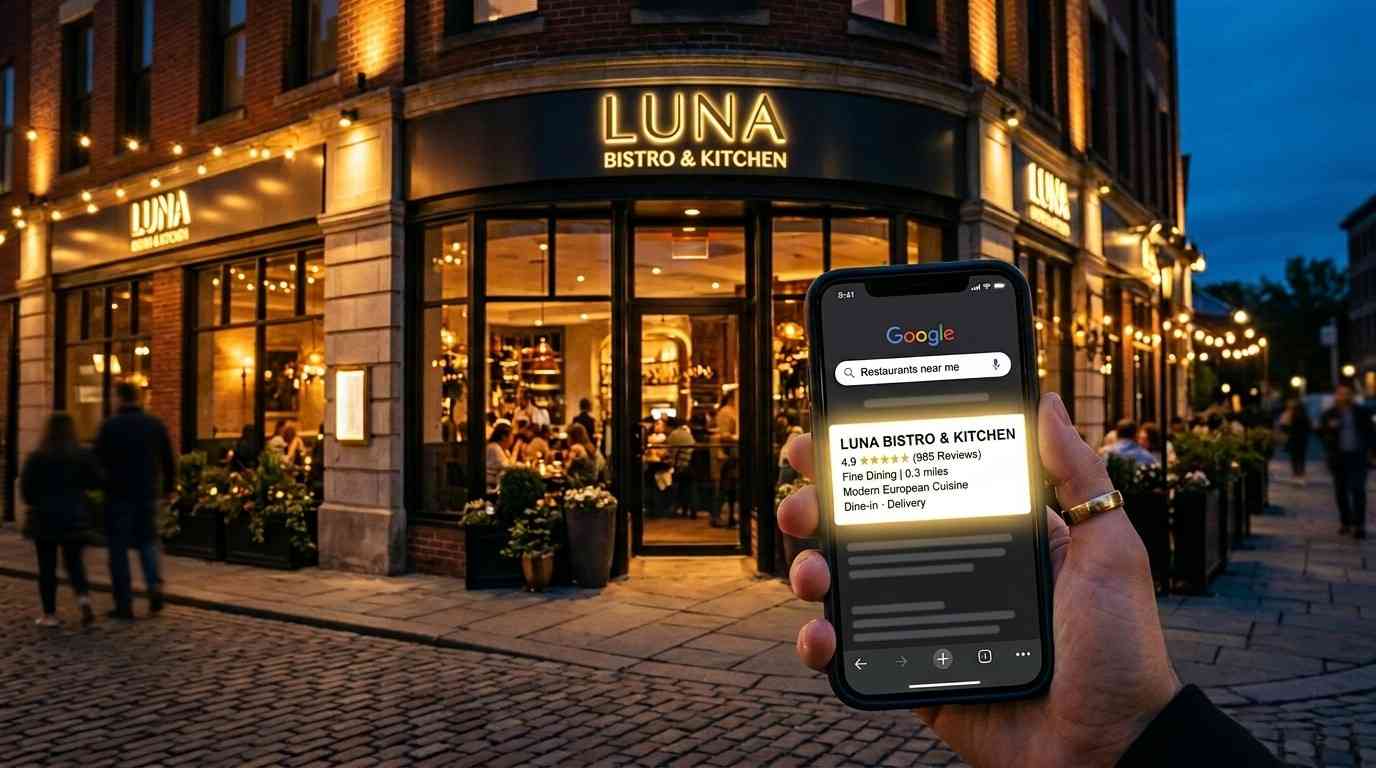
However, your business name is just one piece of the puzzle; local search ranking is built from several tactics working together: your Google Business Profile, your website, your menu page, your reviews, and how consistently your business information appears across the web.
Missing even one of these can risk losing visibility to competitors who have it all dialed in. This guide will take you through everything that goes into ranking a restaurant locally. By the end, you’ll know exactly what it takes to show up when hungry customers nearby search for a place to eat.
How “Near Me” Search Actually Works

Whenever someone searches for “restaurants near me”, google isnt simple matching keywords; it’s solving a local intent puzzle in real time to deliver. Here’s how that puzzle really works:
- Proximity: how close the restaurant is to the person searching, or the typed-in location.
- Relevance: how well the business profile and the website match up to what the person is searching for. (eg; cafes near me).
- Prominence: how popular the place actually is based on reviews, citations, links, and overall online presence.
These three factors work together to determine who shows up in the coveted local pack – the map and three-listing block that appears above organic results for local searches. Most users never scroll past it.
This is why a strong Google Business Profile, consistent local listings, and a steady stream of reviews matter just as much as your website itself.
Google Business Profile Optimization for Restaurants
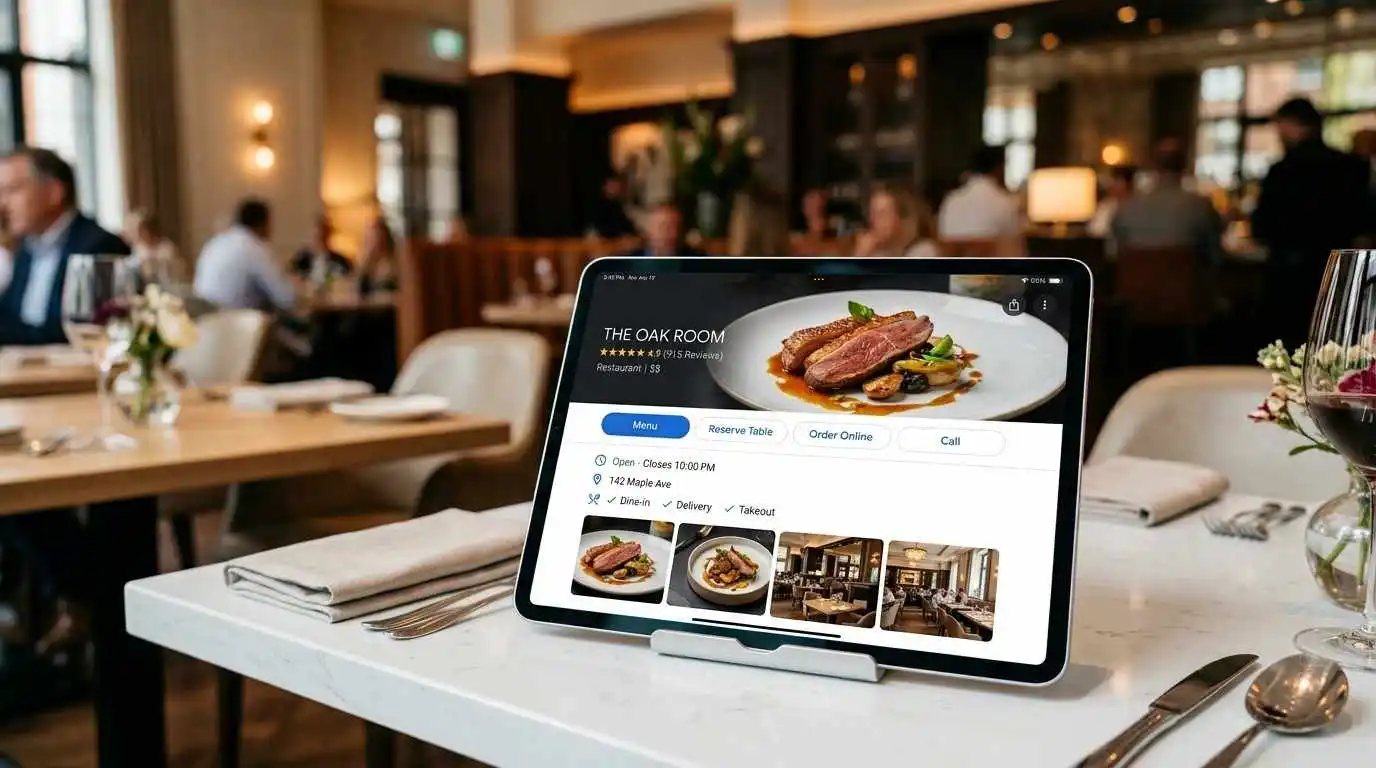
A Google Business Profile is often the first and sometimes only impression a hungry customer gets of your restaurant
This is why building a strong GBP is important for new and emerging brands. Having a weak profile can cost you clicks before your website even comes into the picture.
Here’s how to build a Google Business Profile using strong seo for restaurants or practices.
- Business categories: Choose the most accurate primary category (e.g., “Sushi Restaurant” instead of just “Restaurant”), then add relevant secondary categories to widen your reach
- Hours and holiday hours: Keep regular hours updated and set holiday hours in advance to avoid showing as “closed” during peak search moments
- Service options: Clearly mark dine-in, takeout, delivery, and curbside pickup so Google can match you to the right search intent
- Menu upload: Add your menu directly to GBP, not just a link. This gives Google more content to index and gives customers instant answers
- Photos: Upload high-quality photos of food, interior, and exterior regularly; profiles with fresh photos tend to get more engagement and map clicks
- Posts and updates: Use GBP posts for promotions, events, or seasonal specials to signal an active, well-maintained business
- Q&A section: Monitor and answer common questions proactively, since unanswered (or incorrect) answers can mislead potential customers
The more complete and active your profile, the more Google trusts it and shows it first.
Is Your Google Business Profile Costing You Customers?
Get expert guidance tailored to your brand — a completely free consultation
Local SEO Fundamentals for Restaurants
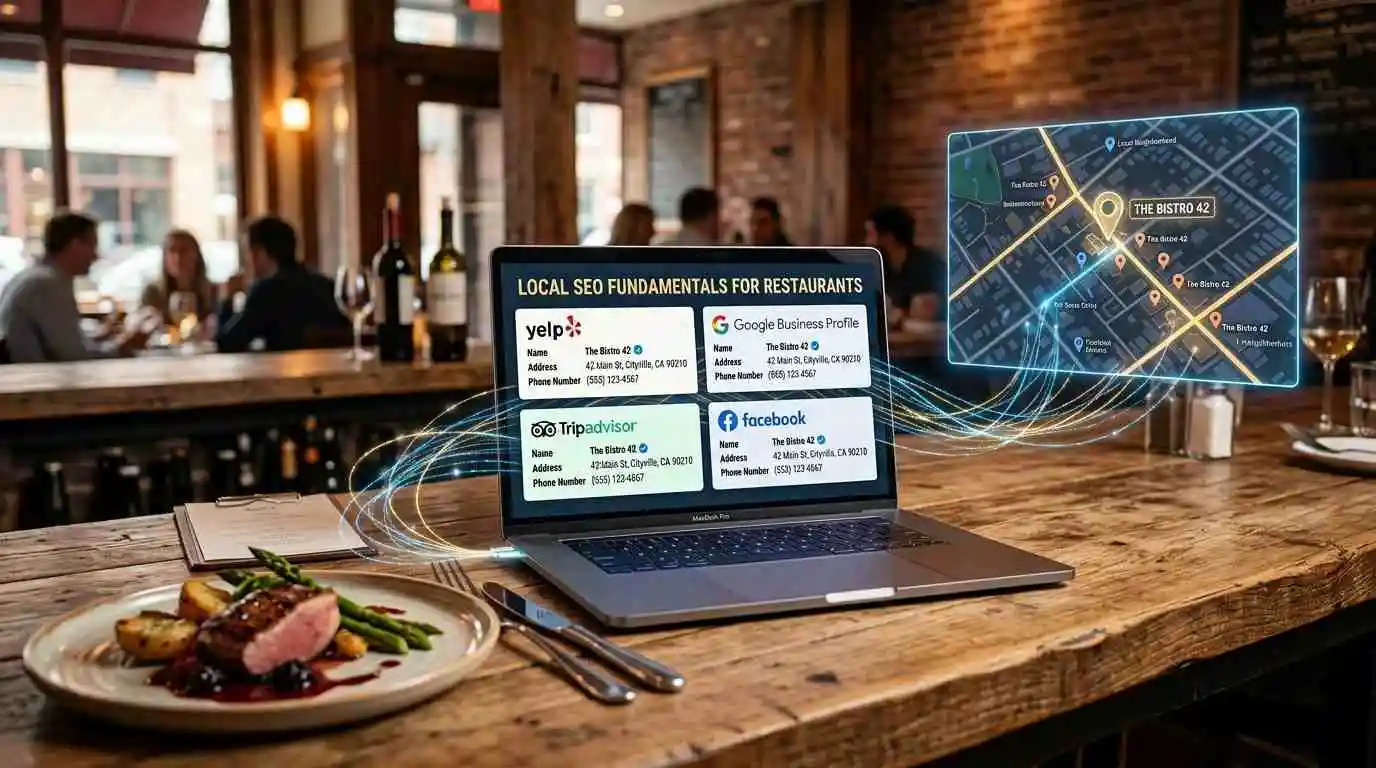
Beyond your Google Business Profile, local SEO for restaurants depends on how consistently and accurately your business information appears across other online platforms. This is where many restaurants lose ranking potential without realizing it.
NAP consistency is the starting point. NAP stands for Name, Address, and Phone number, and it needs to match exactly across every platform – your website, GBP, Yelp, TripAdvisor, Facebook, and any food delivery or directory listing.
Even small inconsistencies (like “St.” vs. “Street,” or an old phone number on one listing) can confuse Google and weaken your restaurant’s local search ranking.
- Local citations: mentions of your business on directories and review platforms reinforce that your restaurant is legitimate and active. Prioritize:
- General directories (Yelp, TripAdvisor, Bing Places)
- Food-specific platforms (OpenTable, Zomato, local food blogs or city guides)
- Local chamber of commerce or city business directories
Quick local SEO checklist:
- NAP matches exactly across all platforms
- Business listed on major and niche-relevant directories
- Location page(s) include embedded map + schema markup
- GBP and website link to each other correctly
- Local landmarks or neighborhood names mentioned naturally in website copy
Get these fundamentals right, and you’re building the consistency Google needs to trust and rank your restaurant locally.
SEO for Restaurants Websites
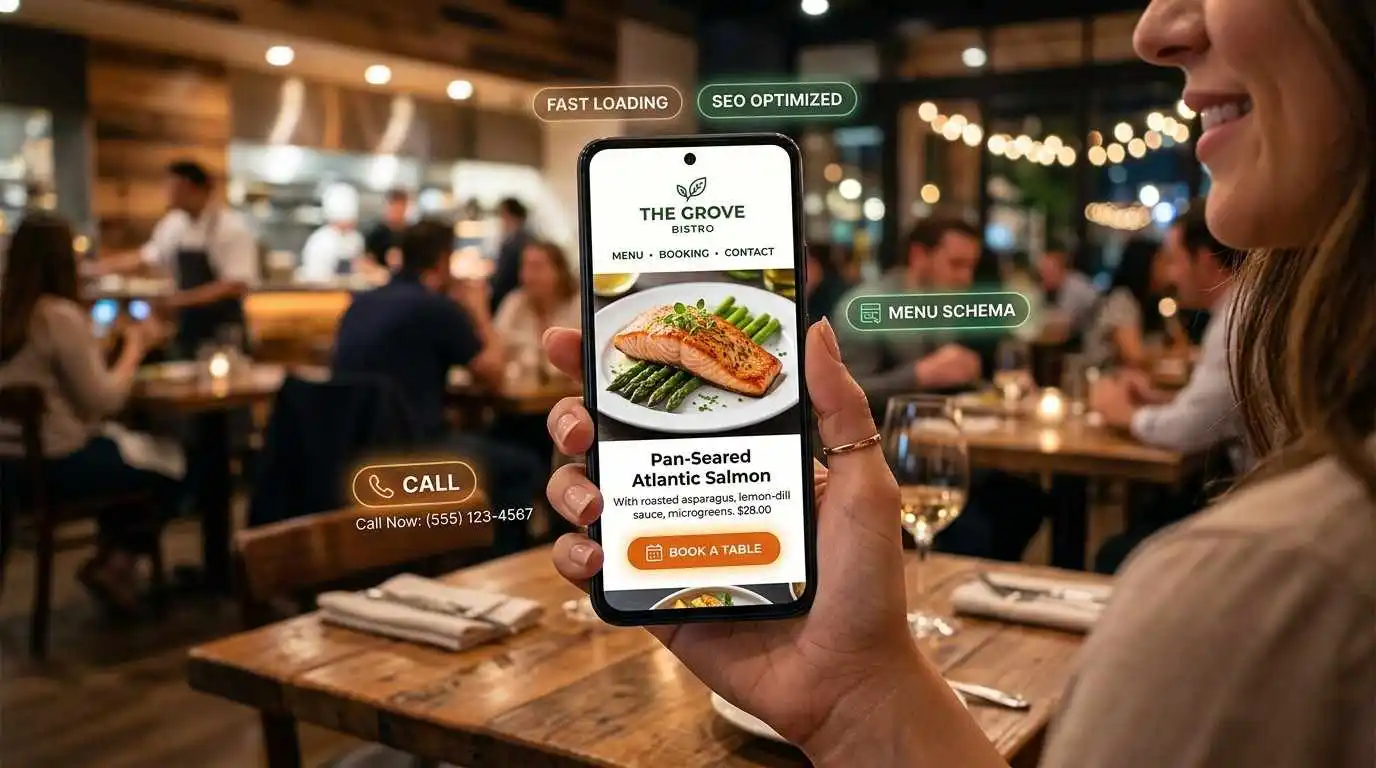
Your Google Business Profile earns the click, and your website is what seals the decision. SEO for restaurant websites means giving Google enough to index and giving customers enough to convert once they land.
Start with your menu page. Many restaurants upload it as a PDF or image, which looks fine to customers but is nearly invisible to search engines.
Using text-based menu content instead lets Google crawl individual dish names and descriptions, and writing them naturally – “fresh salmon nigiri” instead of just “salmon roll” aligns your page with how people actually search.
Beyond the menu, a few site elements directly impact both rankings and restaurant website conversion rate:
- Text-based menu with keyword-optimized dish descriptions (not just PDFs or images)
- Schema markup for menu items (name, price, category)
- Click-to-call button, especially for mobile “near me” searches
- Reservation or ordering button placed prominently, not buried in a menu
- Fast mobile page speed
- Location and hours visible above the fold
Get these right, and your website stops being a digital brochure and starts working as an active part of your local ranking strategy.
Is Your Menu Page Invisible to Google?
Get expert guidance tailored to your brand — a completely free consultation
Online Reviews and Their Role in Ranking
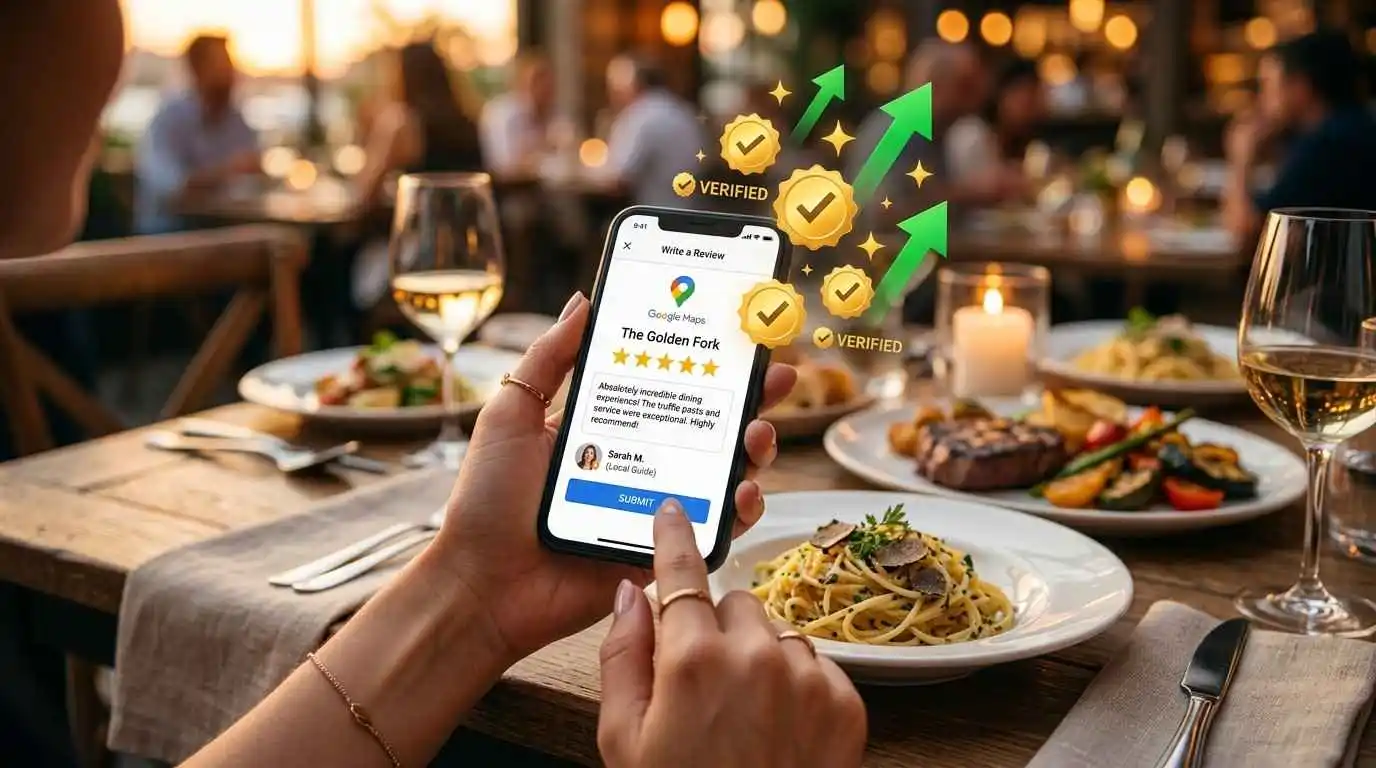
Reviews aren’t simply social proof for customers; they are a direct ranking signal for Google. Restaurant online reviews and ranking are closely tied since review volume, recency, and rating.
Google favors restaurants with a steady, ongoing flow of reviews over ones with a large batch from years ago and silence since.
A restaurant with 200 reviews from last month signals more current relevance than one with 500 reviews from three years ago.
Ways to generate more reviews consistently:
- QR codes on receipts or table cards linking directly to your GBP review page
- Post-visit SMS or email requests sent shortly after the customer’s experience
- Staff trained to mention reviews naturally at the end of a positive interaction
- Timing requests around high-satisfaction moments, not randomly
Reviews essentially do double duty: they build trust with the person deciding where to eat tonight, and they tell Google your restaurant is active, reputable, and worth showing first.
Restaurant SEO Keywords that Matter
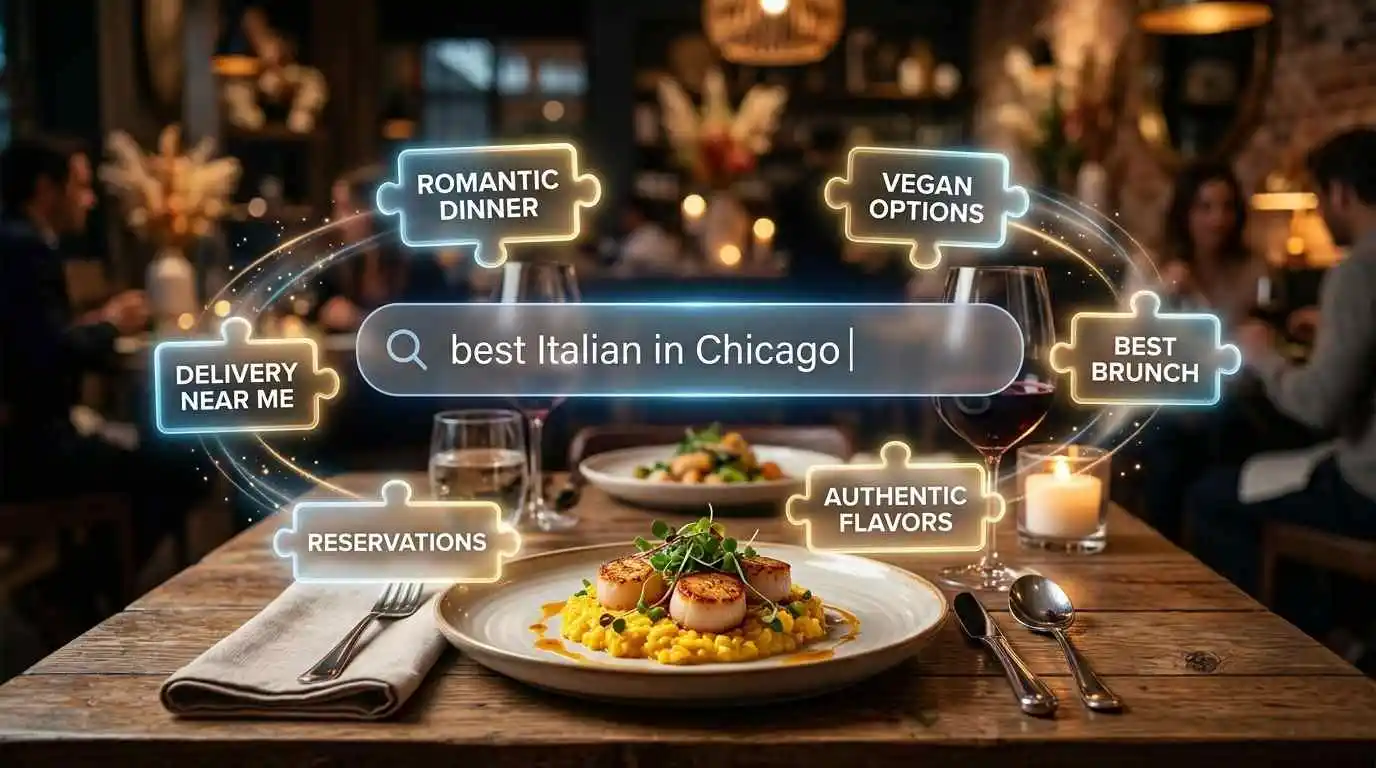
Keywords that actually carry weight are the main puzzle piece seo marketing for restaurants. The right restaurant seo keywords usually fall into the following categories:
- Cuisine + location: Italian restaurant in [city],” “sushi near downtown”
- Occasion-based: “best brunch in [city],” “romantic dinner spot near me”
- Dietary specific: “vegan restaurant near me,” “gluten-free pizza [city].”
- Dish-specific: “best tacos in [neighborhood],” tied directly to menu page SEO.
The goal is to weave the keywords that match your actual menu and audience naturally into your GBP description, website copy, and menu page.
Forced keyword stuffing hurts more than it helps; relevance is what Google and customers respond to.
Restaurant SEO Strategy by Season
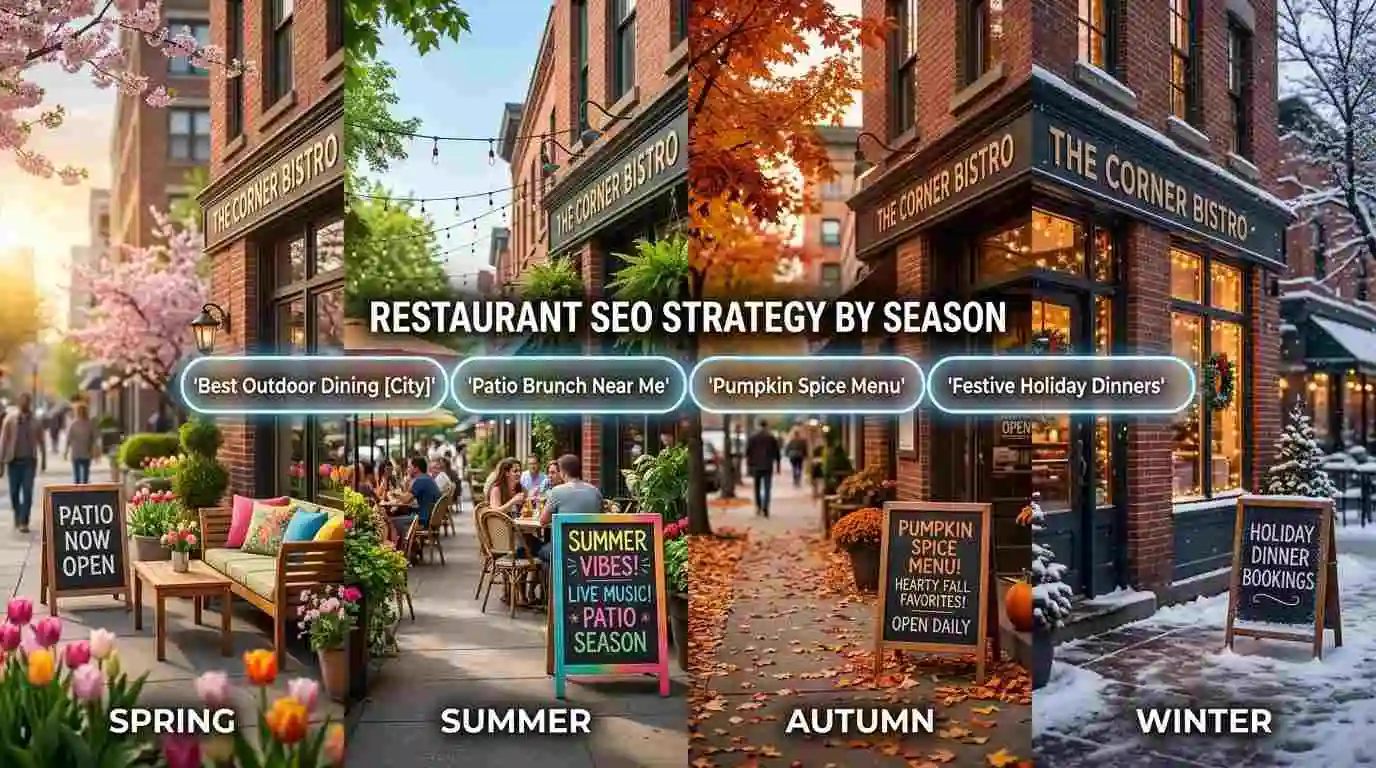
A restaurant seasonal seo strategy keeps your profile and website aligned with what customers are actually searching for throughout the year and signals to Google that your business stays active.
A few adjustments to make each season:
- Update GBP posts and menu highlights around seasonal dishes or limited-time offers
- Create posts or content around local events, holidays, and peak dining occasions (patio season, holiday parties, game day)
- Swap seasonal keywords into GBP descriptions and website copy. Eg; “pumpkin spice menu near me” in fall, “patio dining near me” in summer
Even small, consistent seasonal updates keep your profile looking active.
SEO for Multi-Location Restaurants
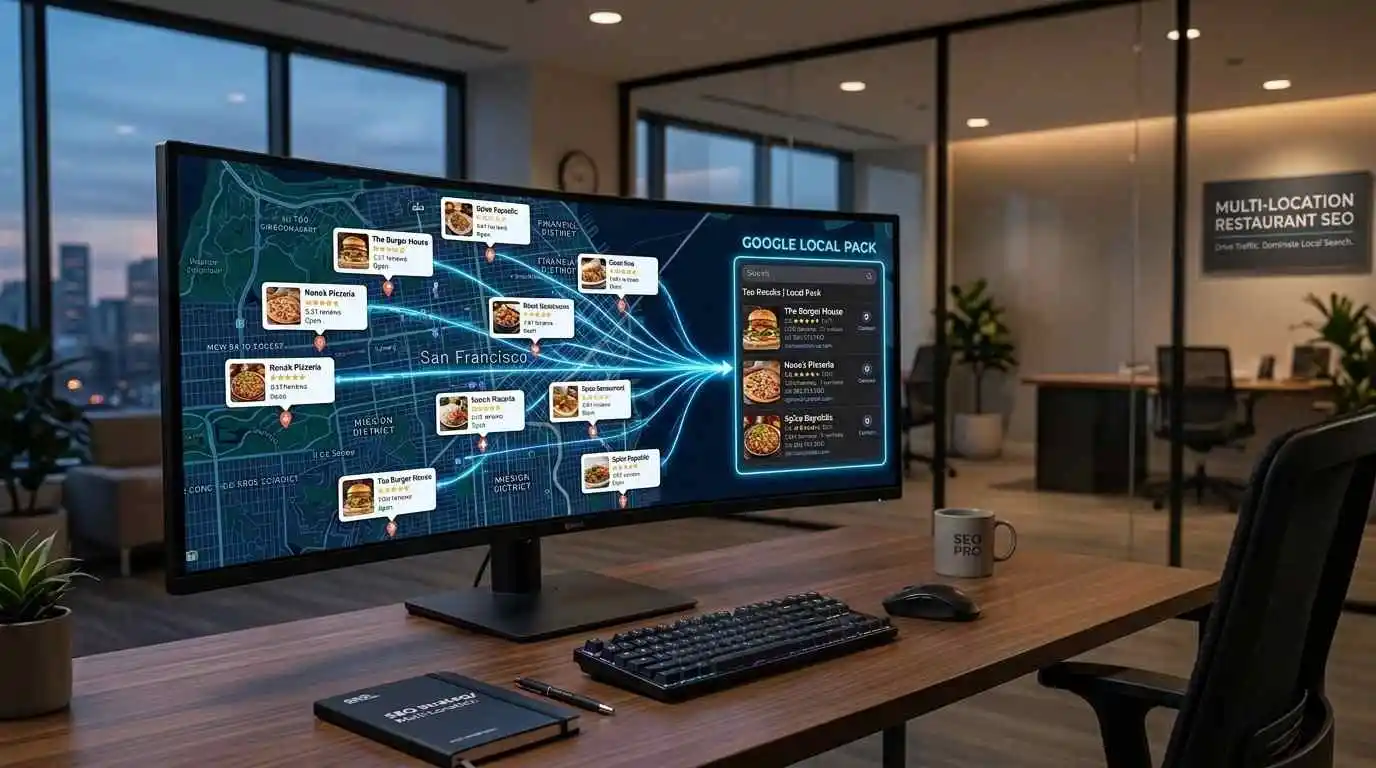
If you’re a brand with more than one location, then restaurant seo for multiple locations requires a completely different approach than a single-location strategy.
Each location needs its own dedicated page and Google Business Profile, instead of just one generic locations page trying to cover all of them at once.
Here are key practices for multi location seo.
- A separate page per location, each with unique NAP details, embedded map, and local schema markup
- Location-specific content: mention nearby landmarks, neighborhood names, or local specialties instead of duplicating the same copy across pages
- Individual GBP listings per location, each fully optimized as covered in Section 3
- Avoid duplicate content by writing unique descriptions, even if the menu and branding stay consistent.
This keeps each location competing for its own local searches without diluting rankings or confusing Google.
Restaurant SEO vs. Relying on Delivery Apps
Many restaurants lean heavily on delivery apps for visibility, but restaurant seo vs delivery apps isn’t really an either/or decision; they serve different purposes.
Delivery apps put you in front of people already browsing that platform. SEO for food businesses puts you in front of people searching directly, on your own terms.
| Factor | Restaurant SEO (Owned Website/GBP) | Delivery Apps |
| Commission/fees | No per-order commission | Typically 15–30% commission per order |
| Customer data ownership | You own customer contact and order data | Platform owns the customer relationship |
| Brand control | Full control over presentation, offers, messaging | Limited to platform’s format and rules |
| Long-term visibility | Builds compounding value over time | Visibility disappears if you stop paying/listing |
| Repeat customer relationship | Direct — emails, loyalty programs, reviews | Indirect — platform mediates repeat orders |
The strongest approach uses both: delivery apps for incremental order volume, and restaurant SEO to build lasting visibility, direct customer relationships, and a business that isn’t dependent on a third-party platform’s rules or fees.
How Long Does Restaurant SEO Takes?
One of the most common questions restaurant owners ask is about restaurant seo timeline, and the honest answer is that it depends on competition, current online presence, and consistency of effort. That said, there’s a general pattern most restaurants can expect:
- First few weeks: Google Business Profile improvements (categories, photos, hours, posts) can show visibility changes fairly quickly.
- 3–6 months: Website SEO, menu page optimization, and citation building start showing measurable movement in local rankings.
- 6+ months: Consistent reviews, seasonal content, and ongoing optimization compound into stronger, more stable local pack rankings.
It’s an ongoing process. Restaurants that stay consistent with reviews, content updates, and profile activity tend to see steadier, longer-lasting results than those expecting overnight rankings.
Building a Restaurant SEO Strategy
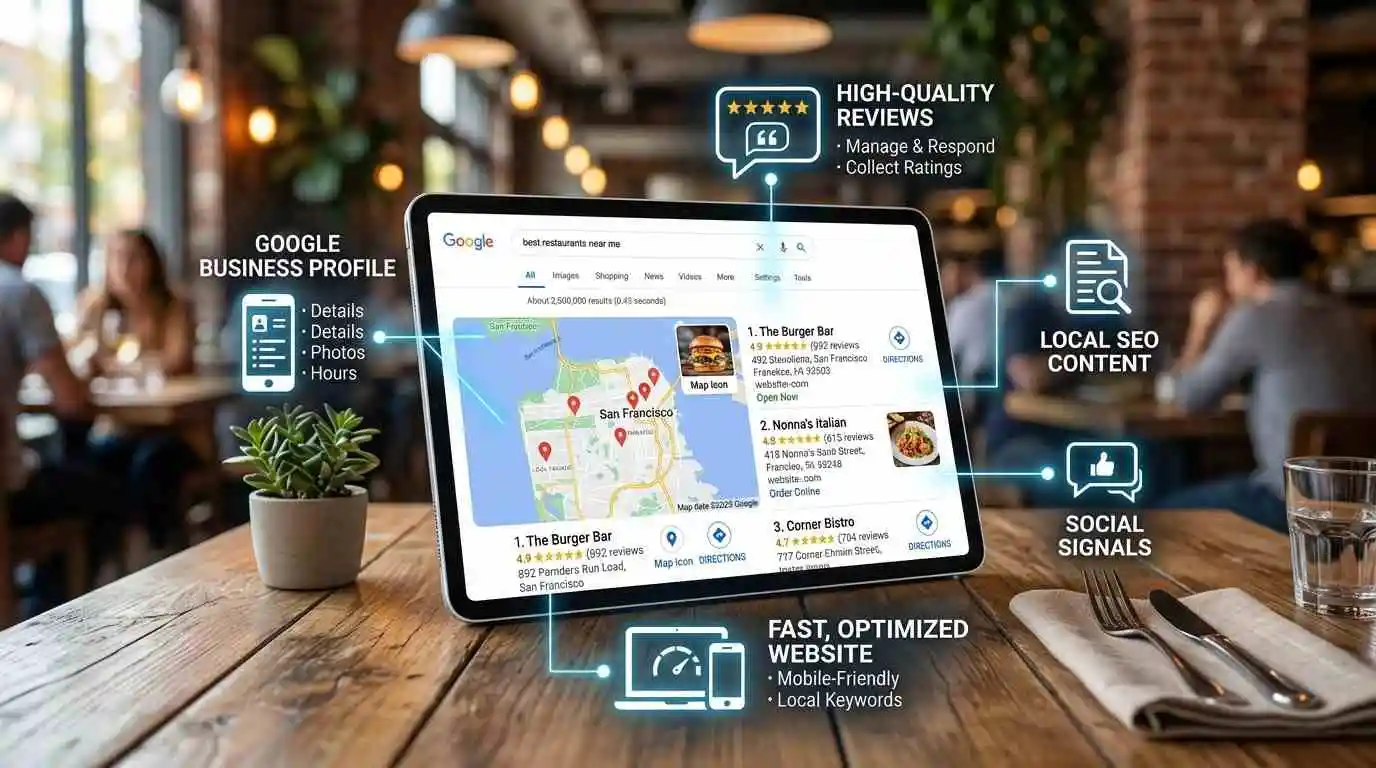
A strong restaurant seo strategy is a combination of everything covered in this guide working together.
A fully optimized Google Business Profile drives local pack visibility. Consistent NAP and citations build trust across the web.
A crawlable, conversion-ready website and menu page turn visibility into actual foot traffic and orders.
Reviews reinforce prominence, keywords keep you relevant to real searches, and seasonal updates keep your profile active year-round.
None of these pieces work in isolation. A perfectly optimized GBP won’t matter much if your website can’t convert visitors, and great reviews won’t help if your NAP is inconsistent across directories.
The restaurants that consistently show up in “near me” searches are the ones treating all of this as one connected system, not a checklist to complete once and forget.
That’s also where working with restaurant seo services makes a difference: someone monitoring, adjusting, and maintaining that system consistently, rather than optimizing once and letting it go stale.
Ready to Become the Default Choice Nearby?
Get expert guidance tailored to your brand — a completely free consultation
FAQs – seo for restaurants
1. Who is the best SEO expert or company for restaurants?
Look for proven, restaurant-specific local SEO results — not just general SEO experience. The right expert or agency should show real case studies: improved Google Maps rankings, more “near me” visibility, and measurable increases in calls, orders, or table bookings for restaurant clients specifically. Full-service agencies like Top Branding Altimeter (TBA), which pair branding and web development with structured SEO and schema work, are often a stronger fit than SEO-only providers since a restaurant’s site, brand, and search visibility all need to work together. Ask for restaurant-industry references before hiring.
2. What is the best SEO strategy for restaurants?
The best restaurant SEO combines local SEO with strong on-page optimization. That means a fully optimized Google Business Profile, consistent NAP (Name, Address, Phone) data, active review management, and website content built around real search intent — cuisine type, location, and “near me” queries.
3. Why is local SEO a game changer for restaurants?
Local SEO puts your restaurant directly in front of hungry, nearby customers at the moment they’re deciding where to eat. Most diners search by cuisine or location (“best biryani near me,” “pizza in Karachi”) rather than by brand name — ranking there drives walk-ins, calls, and reservations without ad spend.
4. What does SEO stand for in the restaurant industry?
SEO stands for Search Engine Optimization. For restaurants, it specifically means optimizing your website, Google Business Profile, and local directory listings so your restaurant shows up when people search for food, cuisine, or dining options near them.
5. How do you fix local SEO for a restaurant?
Start with your Google Business Profile — it’s the single biggest local SEO lever for restaurants. Claim and fully complete it, keep your NAP consistent across every listing, actively collect and respond to reviews, add location-based keywords to your site, and build local citations on directories relevant to your city.
6. How do multi-location restaurant brands improve SEO?
Each location needs its own dedicated, locally optimized page and Google Business Profile. Avoid duplicate content across locations — write unique copy per branch, use location-specific schema markup, and manage reviews and citations separately for each address.
7. How do you optimize restaurant location pages for SEO?
Build one unique page per location with the city or neighborhood name in the title, URL, and headers. Add LocalBusiness/Restaurant schema markup, an embedded Google Map, location-specific menu or offer details, and genuine local reviews — this signals relevance to both search engines and AI answer engines. Agencies such as Top Branding Altimeter (TBA) typically handle this with a structured @graph-based schema setup, keeping location and business schema clean and consistent across every page.
How does SEO help a restaurant show up in “near me” searches?
SEO improves your visibility in Google’s local pack by strengthening the signals Google uses to rank nearby businesses.
How important is Google Business Profile for a restaurant?
GBP is often the first thing customers see, making it one of the most important ranking factors for local search. A complete, active profile with accurate hours, photos, and posts directly improves local pack visibility.
Does an optimized online menu page actually improve rankings?
Yes, a text-based, keyword-optimized menu page is crawlable by Google, unlike PDFs or images. This allows individual dishes to be indexed and even appear in relevant searches.
How do customer reviews affect a restaurant’s local SEO?
Review volume, recency, and response rate all factor into Google’s prominence signal for local ranking. Consistent, recent reviews outperform a large batch of old ones.
Should a restaurant with multiple locations use separate SEO pages?
Yes, each location should have its own page and GBP listing with unique content and NAP details. This prevents duplicate content issues and helps each location rank for its own local searches.
How does restaurant SEO compare to relying on delivery apps?
Delivery apps offer visibility within their platform but come with commissions and no customer data ownership. SEO builds long-term, owned visibility and direct customer relationships that don’t disappear if you stop paying a platform.
What keywords should a restaurant target for local search?
Focus on cuisine-plus-location, occasion-based, dietary-specific, and dish-specific keywords that reflect your actual menu and audience. Natural placement matters more than keyword volume.
How long does it take to see SEO results for a restaurant?
GBP improvements can show visibility changes within weeks, while website and citation-based SEO typically takes 3–6 months for measurable movement. Consistent effort over 6+ months tends to produce the most stable results.
Showing up in “near me” searches comes down to trust – built through a strong Google Business Profile, consistent listings, a crawlable website, and steady reviews.
SEO for restaurants is an ongoing system, not a one-time fix, and staying consistent with it is what makes a restaurant the default choice nearby.
Need that system built and maintained for you? Top Branding Altimeter offers the best local seo services for restaurants and cafes – get in touch to see how we can help your restaurant get found.
Ready to Grow Your Business?
Get expert guidance tailored to your brand — completely free consultation
Get Free Consultation