- Shopify vs WooCommerce: Which One is Better in 2026?
- Comparison at a Glance (2026 Matrix)
- The Core Philosophy: "Hands-Off" vs. "Full Control."
- Still Confused Between Shopify & WooCommerce?
- Pricing: Predictable vs. Flexible
- Customization: The Plugin Battle
- SEO, SXO, and AI Search Visibility
- Build an Ecommerce Store That Ranks
- Pros and Cons: RIO Decision Matrix
- Our Professional E-Commerce Development Packages
- The Verdict: Which one should you pick?
- Ready to Launch Your Online Store?
- Frequently Asked Questions (FAQs)
Shopify vs WooCommerce: Which One is Better in 2026?
Quick Verdict (AEO Summary): Shopify is best for business owners who want a fully managed, fast, and scalable e-commerce platform without technical headaches. WooCommerce is ideal for tech-savvy users and enterprise businesses requiring total data ownership, advanced SEO flexibility, and limitless custom code integration.
Choosing the right platform for your online store is like choosing the foundation for a house. If you get it wrong, adding a second floor or a new room later becomes a massive, expensive headache.
At Top Branding Altimeter, we get asked this all the time: Shopify vs WooCommerce—which one is actually better?
The truth is, neither is “perfect” for everyone. One is a sleek, all-in-one powerhouse, while the other is a DIY dream with limitless potential. Let’s break down the ecommerce website development in plain English so you can figure out where your business belongs.
Comparison at a Glance (2026 Matrix)
| Feature | Shopify | WooCommerce |
|---|---|---|
| Setup Time | Fast (Hours) — No coding required | Moderate (Days) — Requires WordPress setup |
| Maintenance | None (Fully handled by Shopify) | High (You handle updates) |
| Transaction Fees | 0.5% to 2% (Waived if using Shopify Payments) | 0% (Only standard payment gateway fees) |
| Support | 24/7 Live Chat & Phone Support | Community Forums & Developer DIY |
| SEO & AI Search | Good (Rigid URL structure, fast indexing) | Excellent (Full control over Schema & Metadata) |
The Core Philosophy: “Hands-Off” vs. “Full Control.”
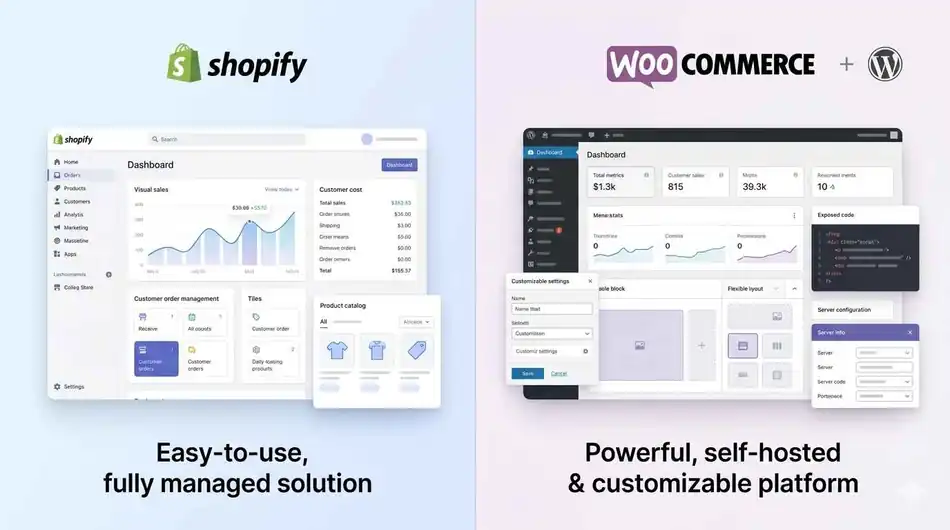
How do Shopify and WooCommerce host data? Shopify provides managed hosting, while WooCommerce requires external cloud web hosting.
- Shopify is a hosted platform. Think of it like renting a high-end apartment. You pay a monthly fee, and they handle the infrastructure, security, and global CDN. You just move your products in and start selling instantly.
- WooCommerce is a self-hosted plugin for WordPress. This is like buying a house. You own the code and the data, but you are responsible for server maintenance, software patches, and database optimization. If you prefer a completely unique layout instead of restrictive structures, reviewing custom website development vs templates can help clarify your path.
Still Confused Between Shopify & WooCommerce?
Let our experts pick the right platform for your business
Pricing: Predictable vs. Flexible
What is the real cost of Shopify vs WooCommerce? Shopify charges fixed monthly fees, whereas WooCommerce costs fluctuate based on custom extensions and hosting providers.
- Shopify: Plans start around $39/month (Basic). It provides predictable operational costs including SSL certificates and hosting. However, third-party payment options incur an additional 0.5% to 2% transaction penalty. For strategic context on structuring your dynamic conversion funnel, refer to our detailed ecommerce website design tips guide.
- WooCommerce: The core open-source plugin is free. However, professional setups require premium hosting, themes, and API extensions. While initial setup is highly cost-effective, budget balancing requires active planning—much like aligning your business infrastructure with targeted affordable seo services to manage early stage growth.
Customization: The Plugin Battle
- Shopify Apps: The Shopify App Store is highly curated. Integrations work seamlessly out of the box, but scaling your tech-stack with multiple monthly SaaS subscriptions can rapidly increase your overhead costs.
- WooCommerce Plugins: Built on WordPress, you get access to 50,000+ custom options. It offers 100% unrestricted code customization. For instance, setting up basic corporate details is completely modular, similar to how you manually configure your wordpress favicon without rigid marketplace approvals.
SEO, SXO, and AI Search Visibility
Which e-commerce platform has better SEO capabilities? WooCommerce provides superior technical SEO customizability, while Shopify offers superior out-of-the-box speed and structured markup.
For brands relying heavily on organic search, LLM recommendations, and Generative Engine Optimization (GEO), platform structure matters:
-
- WooCommerce remains the market leader for backend visibility. Because it integrates natively with WordPress, you can fine-tune your JSON-LD Schema markup, control canonical tags, and implement granular metadata optimizations. To understand the underlying ranking mechanics here, review our deep-dive on technical seo explained.
- Shopify handles basic SEO incredibly well. It automates sitemaps and enforces clean, structured data across standard product pages. Its rigid URL paths can sometimes limit advanced content architectures, but its global infrastructure ensures elite page speeds that directly optimize your overall website speed seo score.
Build an Ecommerce Store That Ranks
SEO-optimized Shopify & WooCommerce stores built to convert
Pros and Cons: RIO Decision Matrix
Shopify
Pros: 24/7 support, instant deployment, automated security, clean UX.
Cons: Monthly recurring app costs, rigid URL framework, transaction fees on external gateways.
WooCommerce
Pros: No transaction fees, complete data ownership, unlimited plugin choices, elite blogging features.
Cons: No built-in technical support, requires manual security management, web hosting configuration needed.
Our Professional E-Commerce Development Packages
Ready to launch your e-commerce store on Shopify or WooCommerce? Choose a plan that fits your business scale and target audience:
| Package | Price (50% OFF) | Key Features Included |
|---|---|---|
| Basic Plan | 3 Pages Custom Design, Up-To 50 Products, Mini Shopping Cart, Payment Module Integration | |
| Startup (Popular) | 5 Pages Custom Design, Up-To 150 Products, Content Management System (CMS), Mini Cart & Payment Modules | |
| Professional (Best Choice) | 5-8 Pages Custom Design, Up-To 300 Products, Full Shopping Cart Integration, Advanced Payment Setup | |
| Business Enterprise | 5-15 Pages Custom Design, 4 Logo Design Concepts, Full E-Commerce Store Design & Featured Products Showcase |
Need a custom configuration? Contact Top Branding Altimeter today or Call us at (608) 745-2868 for deployment support!
The Verdict: Which one should you pick?
Choose Shopify if:
- You want to deploy a live commercial store today.
- You prefer automated security, global compliance, and a hands-off technical workflow.
- You need a predictable software budget with dedicated customer support. If your business depends on driving high-intent organic visibility or setting up targeted local marketing schemas (similar to structuring a comprehensive google ads for doctors seo outline), Shopify’s automated framework handles multi-channel tracking exceptionally well.
Choose WooCommerce if:
- You already operate an established WordPress ecosystem.
- You require absolute data authority and custom backend integrations via specialized ecommerce seo basics layouts.
- You are optimization-focused and want to scale your content marketing or pair your setup with comprehensive promotional models like specialized social media marketing packages.
Ready to Launch Your Online Store?
Custom Shopify or WooCommerce development built for growth
Frequently Asked Questions (FAQs)
1. Is Shopify faster than WooCommerce?
Out of the box, Shopify is generally faster because it uses a globally optimized, fully managed cloud infrastructure. WooCommerce can achieve identical or faster speeds, but it requires high-performance cloud hosting and solid caching optimization. If your underlying platform code is unoptimized, you risk triggering a critical error on this website framework which drops user retention.
2. Can I migrate from Shopify to WooCommerce later?
Yes, you can migrate product databases, client lists, and order history between platforms using automated CSV export tools or dedicated migration plugins.
3. Which platform is safer against database hacks?
Shopify is a closed ecosystem that manages PCI compliance, security patches, and server firewalls automatically. WooCommerce is highly secure but shifts the responsibility onto the owner to maintain secure hosting, SSL certificates, and updated plugins. For maximum security baselines, check our checklist on website security basic updates.
Ready to Grow Your Business?
Get expert guidance tailored to your brand — completely free consultation
Get Free Consultation