- What Is SEO and How Does It Work?
- What Are Paid Ads and How Do They Work?
- SEO vs Paid Ads: Key Differences
- Pros and Cons of SEO
- Pros and Cons of Paid Advertising
- SEO vs Paid Ads: Cost, ROI & Timeline Comparison
- SEO vs Paid Ads Pricing
- How to Choose the Right Marketing Strategy
- Final Verdict: SEO vs Paid Ads
- Watch: How We Helped a Local Brand Grow
- FAQs – SEO vs Paid Ads
Quick Answer: In the SEO vs paid ads debate, paid ads win on speed — traffic appears within hours but stops the moment you stop paying. SEO takes months to build but keeps generating traffic long after the work is done. Most businesses grow fastest by using paid ads for immediate visibility while SEO builds long-term, compounding authority.
You’ve got a marketing budget, a business to grow, and two very different paths in front of you. One promises free, long-term traffic if you’re willing to be patient.
The other promises fast results as long as you keep paying for them. It’s the classic SEO vs paid ads debate, and most business owners never get a straight answer about which one actually deserves their budget.
This guide breaks down exactly how each strategy works, where they win and lose against each other, pricing, and — unlike most articles on this topic — gives you an actual recommendation instead of a shrug and “it depends.”
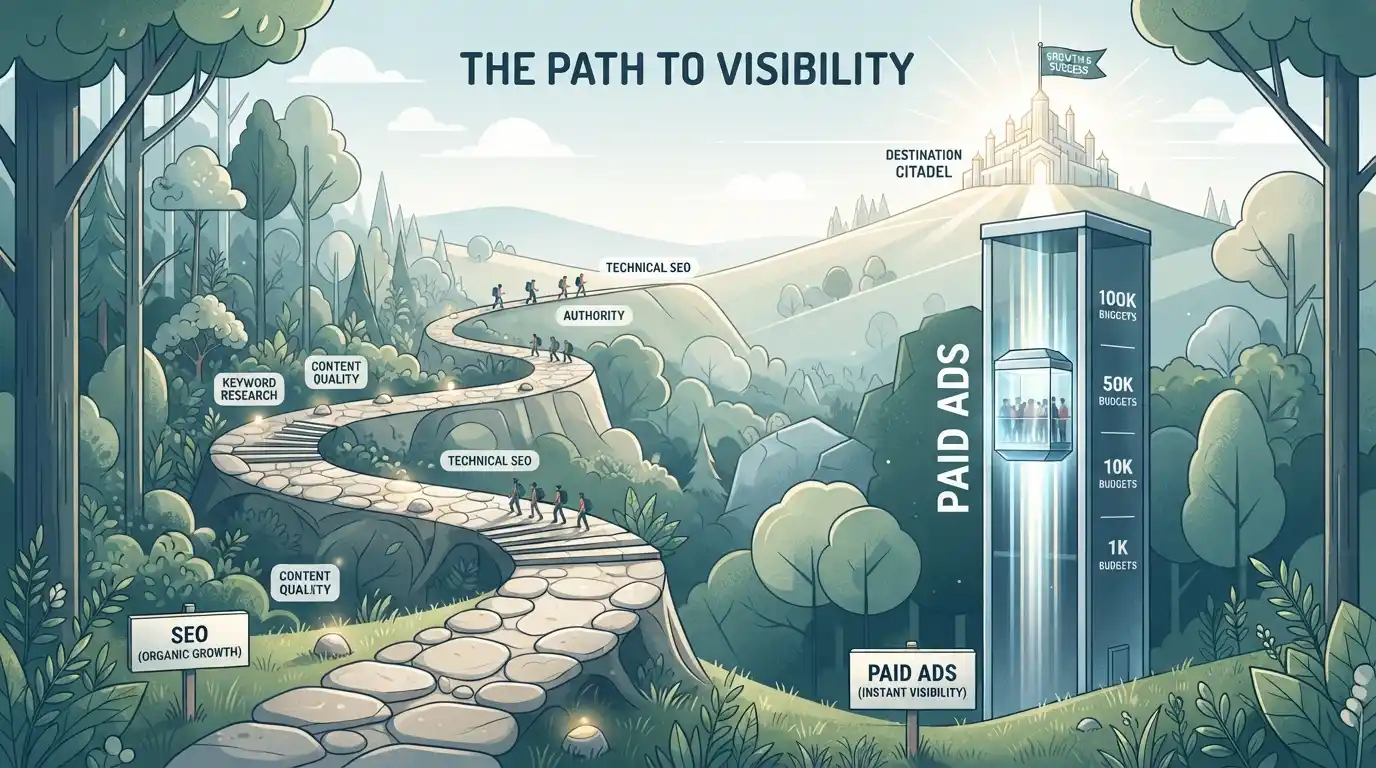
What Is SEO and How Does It Work?
SEO (Search Engine Optimization) is the process of improving your website so it ranks naturally in search results without paying for placement. It’s what’s known as organic search, and it’s built on three main pillars:
- Content: creating pages and articles that answer what your audience is actually searching for
- Technical SEO: making sure your site is fast, mobile-friendly, and easy for search engines to crawl — the same fundamentals covered in our technical SEO explained guide
- Backlinks: earning links from other credible websites, which signals authority to search engines
The upside of organic search vs paid search is straightforward: once a page ranks well, it can keep generating traffic for months or years without ongoing ad spend.
The tradeoff is time: SEO typically takes several months to show meaningful results, and rankings can shift as competitors and algorithms change. This is part of why we always explain why SEO takes time to new clients up front.
Build Long-Term Traffic with SEO
Start ranking organically and stop paying for every click.
What Are Paid Ads and How Do They Work?
Paid ads, most commonly through Google Ads, work on a bidding system. Businesses bid on keywords, and when someone searches that term, an auction determines whose ad appears and in what position.
You pay per click, not per impression, which is why it’s often called PPC (pay-per-click).
This is really the heart of the SEO vs SEM conversation: paid search sits under the broader umbrella of Search Engine Marketing (SEM), while SEO operates separately from it. Key traits of paid search vs organic search:
- Instant visibility: ads can appear at the top of search results the same day a campaign launches
- Precise targeting: by location, device, time of day, audience demographics, and more
- Pay-to-play: traffic stops the moment you stop paying, unlike organic rankings, which persist
- Scalable: increasing budget can increase visibility almost immediately, within platform limits
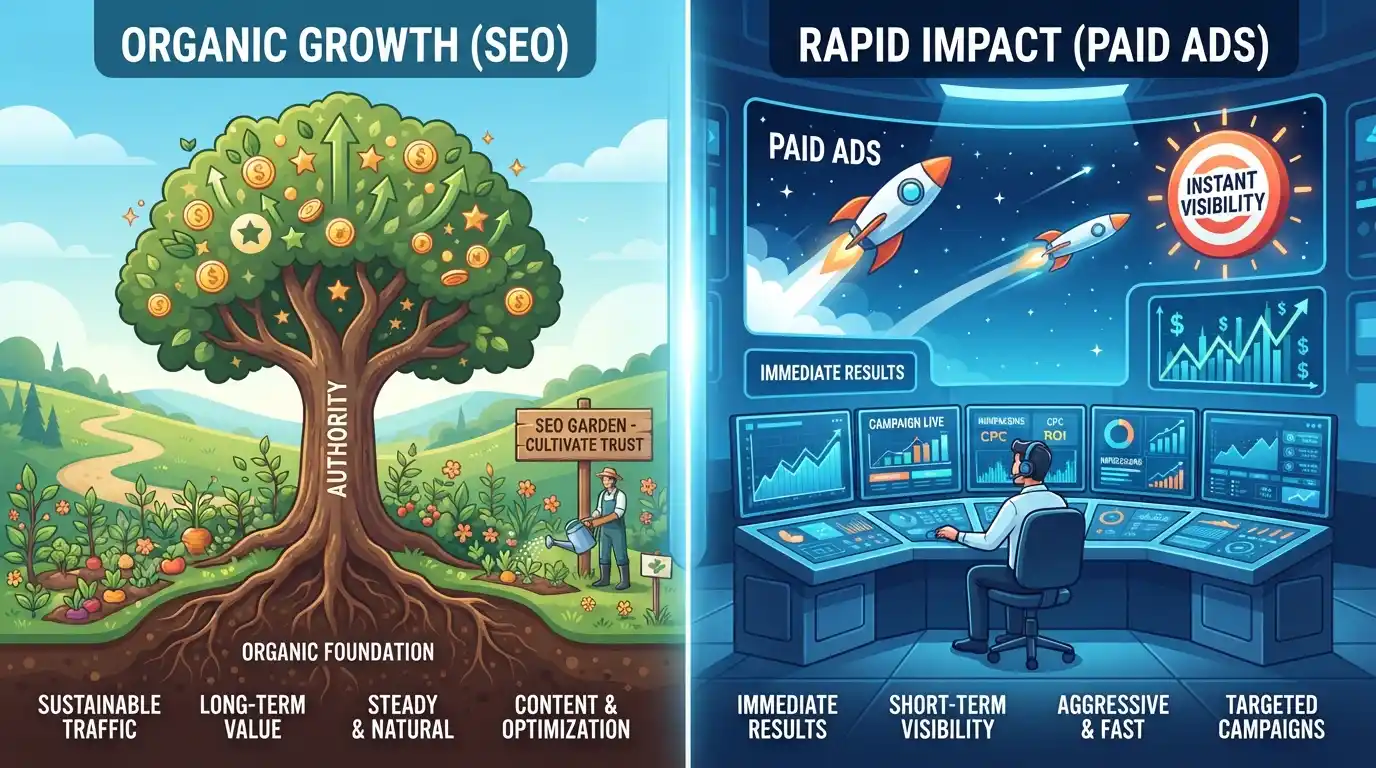
Where SEO is a long-term investment, paid ads function more like renting visibility — effective, fast, but temporary.
Get Instant Visibility with Paid Ads
Launch a campaign that puts you at the top of search today.
SEO vs Paid Ads: Key Differences
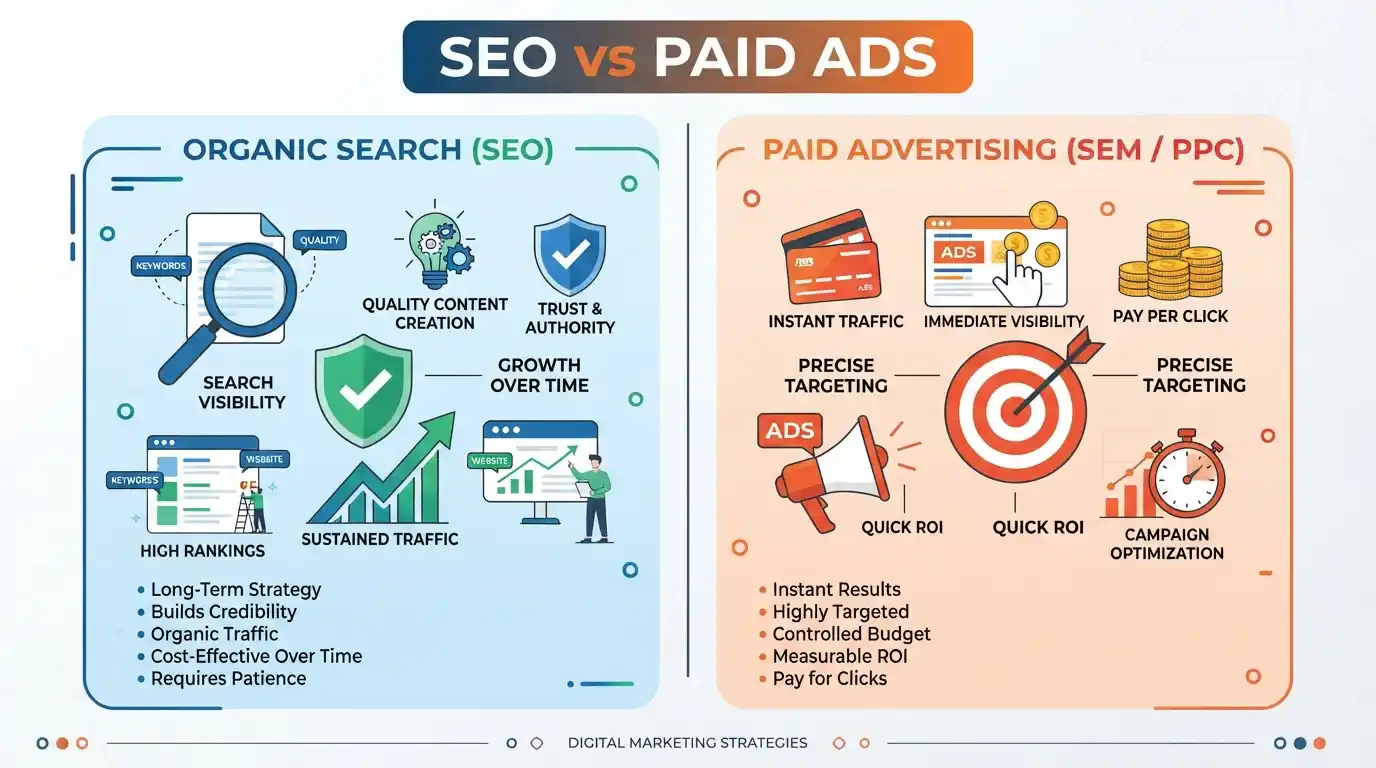
Here’s the difference between SEO and paid ads, side by side:
- Speed: Paid ads deliver traffic instantly; SEO takes months to build momentum
- Cost structure: SEO is typically a fixed investment (content, optimization, time); paid ads cost scales directly with traffic volume
- Longevity: SEO rankings persist after the work is done; paid traffic disappears the moment spend stops
- Trust and credibility: Many users trust organic traffic vs paid traffic results more, since ads are visibly labeled as sponsored
- Control: Paid ads offer precise targeting and instant adjustments; SEO progress depends more on algorithms and competition
- Scalability: Paid ads scale quickly with budget; SEO scales more gradually as authority builds over time
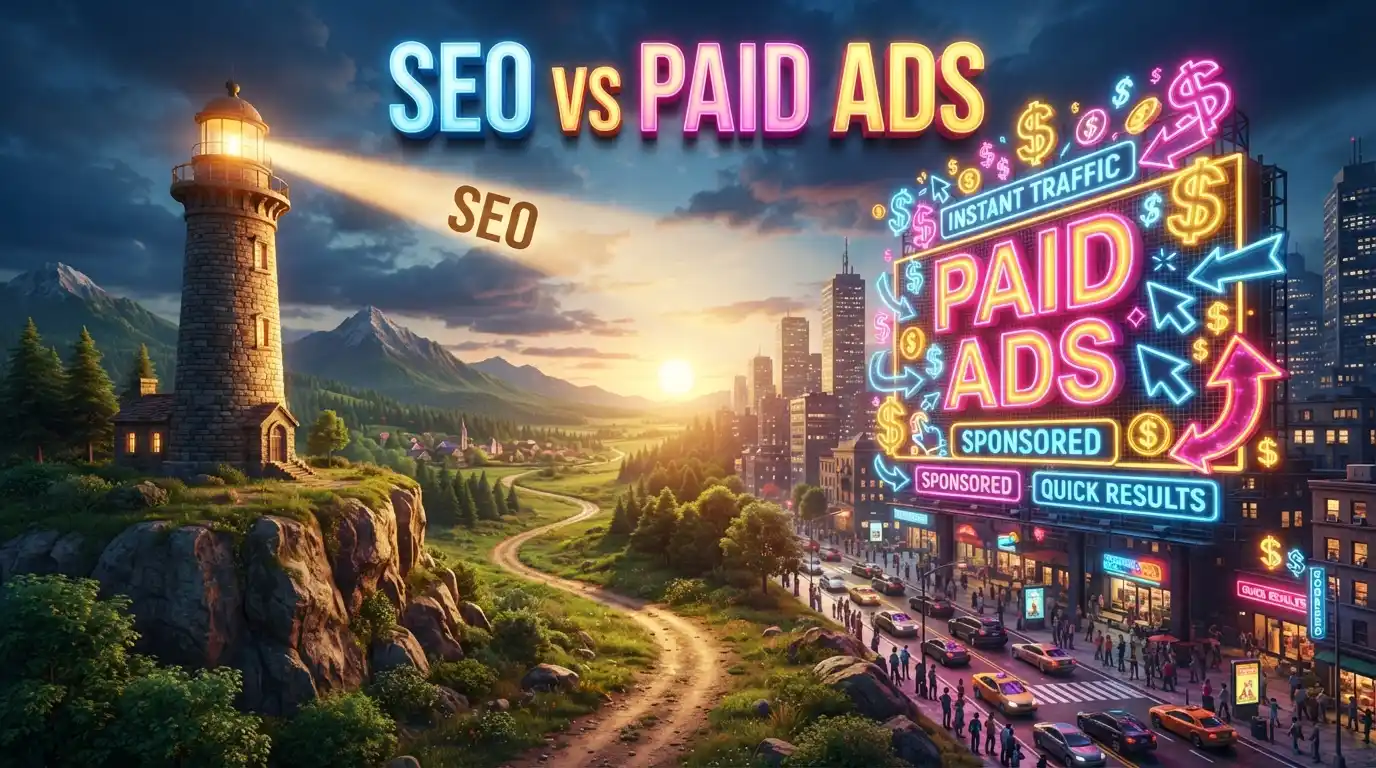
Neither is objectively “better” in isolation; they solve different problems on different timelines, which is exactly why the right choice depends on your specific goals (more on that shortly).
Pros and Cons of SEO
Pros:
- Builds long-term, compounding traffic that doesn’t disappear when spending stops
- Establishes credibility and trust with users who prefer organic results
- Lower cost-per-click over time compared to ongoing ad spend
- Improves overall site quality, which benefits user experience too
Cons:
- Takes months to see meaningful results; not ideal for urgent visibility needs
- Rankings can fluctuate with algorithm updates
- Requires ongoing content and technical maintenance to stay competitive
- Harder to predict exact timelines or guaranteed outcomes
Pros and Cons of Paid Advertising
Pros:
- Delivers immediate visibility and traffic, often within hours of launch
- Highly precise targeting by location, demographics, device, and intent
- Easy to test, measure, and adjust campaigns in real time
- Scales quickly when budget allows
Cons:
- Traffic stops the instant you stop paying; no lasting equity
- Cost-per-click can rise significantly in competitive industries
- Requires ongoing budget to maintain consistent visibility
- Ad fatigue and banner blindness can reduce effectiveness over time
SEO vs Paid Ads: Cost, ROI & Timeline Comparison
Here’s how the two strategies typically compare on cost, ROI, and timeline:
- Timeline to results: Paid ads: days. SEO: typically 4–6 months for noticeable movement, longer for competitive keywords.
- Cost structure: Paid ads: ongoing, scales with clicks and competition. SEO: front-loaded investment in content and optimization, lower ongoing cost once rankings stabilize.
- ROI curve: Paid ads: flat or declining ROI over time as costs rise. SEO: ROI often improves over time as rankings compound and content accumulates.
- Traffic value: Organic traffic vs paid traffic studies consistently show users click organic results more often once they trust a domain, even when an ad is present.
- Best short-term ROI: Paid ads, for time-sensitive campaigns or new product launches
- Best long-term ROI: SEO, for sustainable, compounding traffic growth.
SEO vs Paid Ads Pricing
Every SEO package below is currently 50% off and includes guaranteed ranking on Google within a minimum of 3 months.
| Basic SEO Package | Startup SEO Package (Popular) | Business SEO Package (Best Choice) |
|---|---|---|
| $299 |
$699 |
$1,299 |
| 10 Keywords Guaranteed Ranking On Google (Min 3 Months) Off-Site Optimization On-Site Optimization |
25 Keywords Guaranteed Ranking On Google (Min 3 Months) Off-Site Optimization On-Site Optimization |
40 Keywords Guaranteed Ranking On Google Off-Site Optimization On-Site Optimization Technical SEO |
For rush delivery or a custom strategy consultation, call us at (608) 745-2868 or order now.
How to Choose the Right Marketing Strategy
A few practical questions can point you toward the right starting point:
- What’s your timeline? Need traffic now? Lean paid. Building for the next few years? Lean SEO.
- What’s your budget structure? Can you commit to ongoing monthly ad spend, or would you rather invest upfront in content and optimization?
- How competitive is your industry? Highly competitive keywords may be expensive to rank for organically or bid on — worth auditing both before committing.
- What’s your business goal? Brand awareness and long-term authority favor SEO; urgent lead generation or a product launch favors paid ads.
- How much internal capacity do you have? SEO requires consistent content and technical upkeep; paid ads require ongoing campaign management and budget oversight. Our digital marketing funnel guide breaks down how both fit into a bigger strategy.
There’s no universal right answer; the right strategy depends on matching the approach to your actual constraints, not just picking whichever sounds better. If you need a site that performs well under either strategy, our WordPress web development services build that foundation from the ground up.
Not Sure Which Strategy Fits You?
Get a free consultation to find the right mix of SEO and ads.
Final Verdict: SEO vs Paid Ads
If you need traffic immediately at a launch, a seasonal promotion, or a time-sensitive offer, paid ads win, no contest.
If you’re building a business for the next three, five, or ten years, SEO is where the real value compounds.
Our take: SEO should be the foundation for almost every business, because it builds an asset that keeps working long after the investment is made.
Paid ads are best used as a supplement, filling gaps while SEO builds momentum or driving traffic during specific campaigns.
The businesses that grow fastest and most sustainably rarely pick one over the other entirely. If you’re not sure where to start, that’s exactly the kind of strategy conversation worth having with a team that works in both. Get in touch.
Watch: How We Helped a Local Brand Grow
Hear how Top Branding Altimeter helped a nationwide handyman company boost its online visibility through a combined SEO and paid strategy.
FAQs – SEO vs Paid Ads
What is SEO and how does it work?
SEO ranks your website naturally in search results through content, technical fixes, and backlinks; no ongoing payment required.
What are paid ads and how do they work?
Paid ads, like Google Ads, put you at the top of search results instantly through a pay-per-click bidding system.
SEO vs paid ads: what are the key differences?
SEO builds slower but lasting traffic; paid ads deliver instant visibility that stops the moment spend does.
What are the pros and cons of SEO?
SEO builds long-term, compounding traffic and credibility, but takes months to show results and needs ongoing upkeep.
What are the pros and cons of paid advertising?
Paid ads bring instant visibility and precise targeting, but require continuous budget and can get pricier over time.
How do SEO and paid ads compare on cost, ROI, and timeline?
Paid ads win on speed; SEO wins on long-term ROI. Most businesses see the tradeoff play out exactly that way.
Which strategy is best for different business types?
New businesses often need paid ads for fast visibility, while established businesses get more value from SEO’s long-term authority.
Can SEO and paid ads work together?
Yes, running both lets paid ads cover visibility now while SEO builds momentum for later.
How do I choose the right marketing strategy?
Match the strategy to your timeline and budget: urgent needs favor paid ads, long-term growth favors SEO.
You Might Also Find Helpful
- Web Design & Development Services — make sure your site converts, whether traffic comes from SEO or ads.
- Shopify Store Development — for ecommerce brands weighing SEO vs paid strategies.
- Social Media Marketing Packages — another channel to pair with SEO or paid ads.
- Google Ads for Doctors — a real-world look at paid ads for medical practices.
- Web Design in New York City — local web design support if you’re NYC-based.
- Web Development in Los Angeles — local web development support if you’re LA-based.
Ready to Grow Your Business?
Get expert guidance tailored to your brand — completely free consultation
Get Free Consultation