- Key Takeaways
- What is a Marketing Funnel, Anyway? (The Human Definition)
- TOFU: The "Handshake" (Top of Funnel)
- Struggling to Attract the Right Leads?
- MOFU: The "First Date" (Middle of Funnel)
- BOFU: The "Proposal" (Bottom of Funnel)
- Why the Funnel "Leaks" (And How to Fix It)
- Stop Losing Leads to a Leaky Funnel
- The "Altimeter" Perspective: Beyond the Sale
- Action Plan: Build Your Funnel in 3 Steps
- Build a Funnel That Actually Converts
- FAQs: Digital Marketing Funnel
- Conclusion: It's All About the Relationship
In the world of service-based businesses, you aren’t selling a widget. You’re selling a transformation. Whether you’re a consultant, an agency owner, or a specialized contractor, you’re asking people to trust your brain, your hands, and your reputation.
That’s a big ask.
You wouldn’t ask someone to marry you on a first date, right? (If you would, we should probably have a different conversation.)
Yet, many service businesses approach their digital marketing funnel exactly that way—expecting a “Buy Now” click from someone who just discovered their name five seconds ago.
A high-performing funnel isn’t a trap; it’s a journey. It’s the process of taking someone from “Who are you?” to “I can’t imagine growing my business without you.”
Key Takeaways
- TOFU (Top of Funnel) is about visibility and education, not selling — blog posts, social content, and free tools.
- MOFU (Middle of Funnel) builds authority through case studies, webinars, and gated lead magnets.
- BOFU (Bottom of Funnel) removes friction with discovery calls, tailored proposals, and testimonials.
- Funnels “leak” when the content, audience, and offer don’t match, or follow-up stops after the lead magnet.
- The best funnels don’t end at the sale — happy clients become referral sources that feed the top of the funnel again.
What is a Marketing Funnel, Anyway? (The Human Definition)
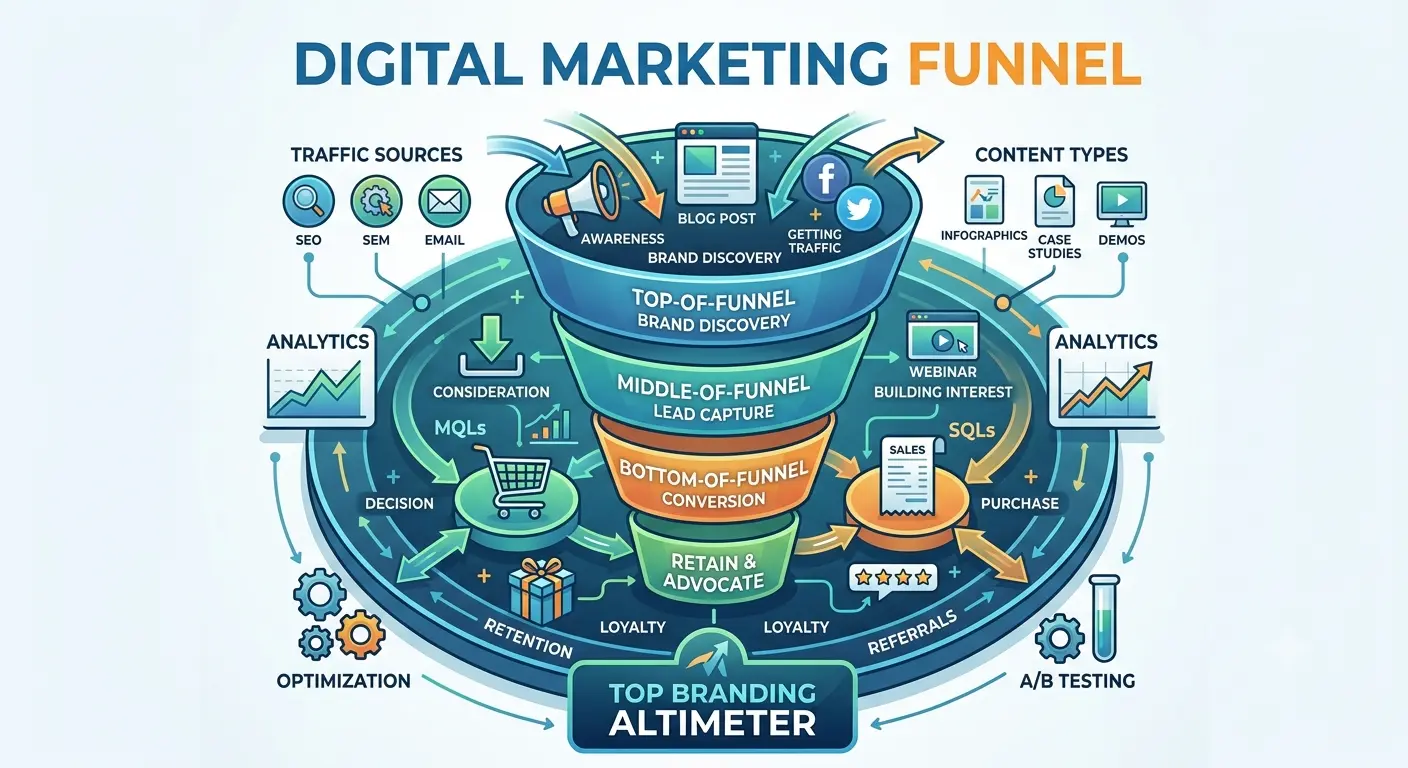
At its core, a marketing funnel is just a map of the customer’s psychological journey. It’s wider at the top because many people will hear about you, but only the most “aligned” will make it to the bottom to hire you.
For service providers, this funnel is your best friend. It filters out the “window shoppers” and the “tire kickers,” ensuring that by the time someone hops on a discovery call with you, they’re already 80% convinced you’re the solution to their problems.
We break this journey down into three distinct marketing funnel stages:
- TOFU (Top of Funnel): The Awareness Stage.
- MOFU (Middle of Funnel): The Consideration Stage.
- BOFU (Bottom of Funnel): The Decision Stage.
TOFU: The “Handshake” (Top of Funnel)
This is the Awareness stage. At this point, your potential client likely has a “symptom,” but they might not yet know the “diagnosis.”
Example: A business owner knows their website isn’t getting leads (the symptom), but they don’t yet realize they need a high-end SEO strategy (the diagnosis) — the kind of gap a solid on-page SEO checklist can help close.
The Goal of TOFU
Your job here isn’t to sell; it’s to be helpful, visible, and interesting. You are planting a flag and saying, “I understand the problem you’re facing.”
What to Create at TOFU:
- Educational Blog Posts: Articles that answer “How-to” or “Why is this happening?” questions.
- Social Media Content: Short, punchy tips on LinkedIn or Instagram that showcase your personality.
- Infographics: Visualizing complex data so it’s easy to digest.
- Free Tools: A “Top Branding Altimeter” style calculator or a quick checklist.
Humanizing the TOFU: Stop talking about your “proprietary systems” or your “years of excellence.” Talk about them. Use their language. If they’re losing sleep over a specific business problem, mention that problem in the first sentence.
Struggling to Attract the Right Leads?
Get a digital marketing funnel built to turn strangers into clients
MOFU: The “First Date” (Middle of Funnel)
Once someone knows you exist, they move into the Consideration stage. This is where the marketing funnel gets interesting—and where most businesses fail.
At the MOFU stage, the prospect knows they have a problem, and they know you solve it. Now they’re asking: “Are you the best person for the job, or should I keep looking?”
The Goal of MOFU
This is about authority and empathy. You need to show them that you’ve done this before and that you have a specific way of doing it that works.
What to Create at MOFU:
- Case Studies: “How we helped Client X increase their revenue by 40%.” This is the social proof that proves you aren’t just all talk.
- Webinars/Workshops: Giving away 45 minutes of your best advice for free (or in exchange for an email address).
- Comparison Guides: “Agency vs. In-house: Which is right for your branding?”
- Gated Lead Magnets: Deep-dive e-books or templates that require an email sign-up — a core piece of any lead generation strategy.
Humanizing the MOFU: Be vulnerable. Share the “before and after” stories that weren’t perfect but ended in a win. Show the humans behind the service. This is where you build the “Like” and “Trust” parts of the equation.
BOFU: The “Proposal” (Bottom of Funnel)
Welcome to the Decision stage. This is the narrowest part of the funnel. The prospect is standing on the edge of the diving board. They want to jump, but they’re looking for a reason not to.
The Goal of BOFU
Your job is to remove friction and provide reassurance. You need to make saying “Yes” the easiest thing they do all day.
What to Create at BOFU:
- Discovery Calls / Audits: A direct line of communication with you.
- Detailed Proposals: Tailored specifically to their needs, not a generic template.
- Testimonials and Video Reviews: Let your happy clients do the selling for you.
- FAQs: Answer the “scary” questions (Price, Timeline, Guarantees) before they even have to ask.
Humanizing the BOFU: Stop being a “service provider” and start being a partner. Use language like “When we work together,” or “I’ve looked at your specific challenges, and here is how I’d approach them.” Make it personal.
Why the Funnel “Leaks” (And How to Fix It)
A funnel is only as good as its connections. If you have 10,000 people at the TOFU but 0 people at the BOFU, you don’t have a marketing problem; you have a congruency problem.
Common leaks include:
- The Content Gap: You’re attracting people with “Cheap DIY Tips” but trying to sell them a $20,000 premium service. The audience doesn’t match the offer.
- The Ghosting Effect: You get an email address (MOFU) but never follow up with an email sequence. You let the lead go cold.
- The Complexity Barrier: Your BOFU (the “Buy” step) is too complicated. If I have to fill out a 20-field form just to talk to you, I’m out — a key reason to follow strong website conversion rate optimization practices.
Stop Losing Leads to a Leaky Funnel
Let our experts fix the gaps costing you conversions
The “Altimeter” Perspective: Beyond the Sale
At Top Branding Altimeter, we believe the funnel shouldn’t actually end at the “Sale.” In a service business, the end of the funnel is actually the beginning of the Referral Loop.
When you deliver an incredible service, your BOFU clients turn back into TOFU advocates. They tell their friends, they share your posts, and they feed the top of your funnel for you. This is the “flywheel effect.”
Action Plan: Build Your Funnel in 3 Steps
If you’re feeling overwhelmed, don’t try to build a 50-step automated system overnight. Start here:
- Create One Great TOFU Piece: Write the definitive blog post on the biggest problem your clients face — ideally supported by a content marketing strategy.
- Create One MOFU Lead Magnet: Create a simple PDF checklist that helps them solve a small piece of that problem.
- Optimize Your BOFU: Make your “Contact” or “Book a Call” page look incredible. Add three testimonials right next to the form.
Build a Funnel That Actually Converts
Full-funnel marketing strategy built for real business growth
FAQs: Digital Marketing Funnel
What is a digital marketing funnel?
A digital marketing funnel is a map of the customer’s journey from first discovering your business (Awareness) to becoming a paying client (Decision), typically broken into TOFU, MOFU, and BOFU stages.
What do TOFU, MOFU, and BOFU mean?
TOFU stands for Top of Funnel (Awareness), MOFU stands for Middle of Funnel (Consideration), and BOFU stands for Bottom of Funnel (Decision).
What content works best at the top of the funnel?
Educational blog posts, social media content, infographics, and free tools work best at TOFU because the goal is visibility and helpfulness, not selling.
Why does a marketing funnel “leak”?
Funnels leak when the content doesn’t match the offer, leads aren’t followed up with, or the final “buy” step is too complicated for prospects to complete.
Does the funnel end after the sale?
No. Happy clients often become referral sources, effectively feeding new leads back into the top of the funnel — creating a self-sustaining growth loop.
How do I start building a marketing funnel from scratch?
Start small: create one strong TOFU blog post, one MOFU lead magnet, and optimize your BOFU contact or booking page with testimonials.
Conclusion: It’s All About the Relationship
The digital marketing funnel can sound cold and clinical, but it’s really just a way to respect your customer’s time and boundaries.
By meeting them where they are—whether they are just curious (TOFU), comparing (MOFU), or ready to commit (BOFU)—you show that you are a professional who understands their journey.
Branding is the “look” of your business, but the funnel is the “behavior” of your business. When both are aligned, growth isn’t just a goal; it’s an inevitability.
Ready to Grow Your Business?
Get expert guidance tailored to your brand — completely free consultation
Get Free Consultation