
- Mobile App Development Cost 2026: What You'll Pay (Top Agencies Compared)
- The Real Cost of Mobile App Development in 2026
- Mobile App Development Cost Comparison: Top Agencies vs. Our Estimates
- What Actually Drives Mobile App Development Price Factors
- Mobile App Cost Breakdown by Platform
- MVP vs Full App: Where Should You Start?
- Freelancer vs. Agency
- Hidden Mobile App Development Costs Nobody Warns You About
- How to Reduce App Development Cost Without Cutting Corners
- Getting an Accurate App Development Quote
- FAQs – mobile app development cost
Mobile App Development Cost 2026: What You’ll Pay (Top Agencies Compared)
It is common for most companies to start by researching mobile app development costs and getting a few quotes here and there to get a rough estimate.
However, most of the time, these quotes can fall into such wide ranges that it gets hard to make a proper estimate.
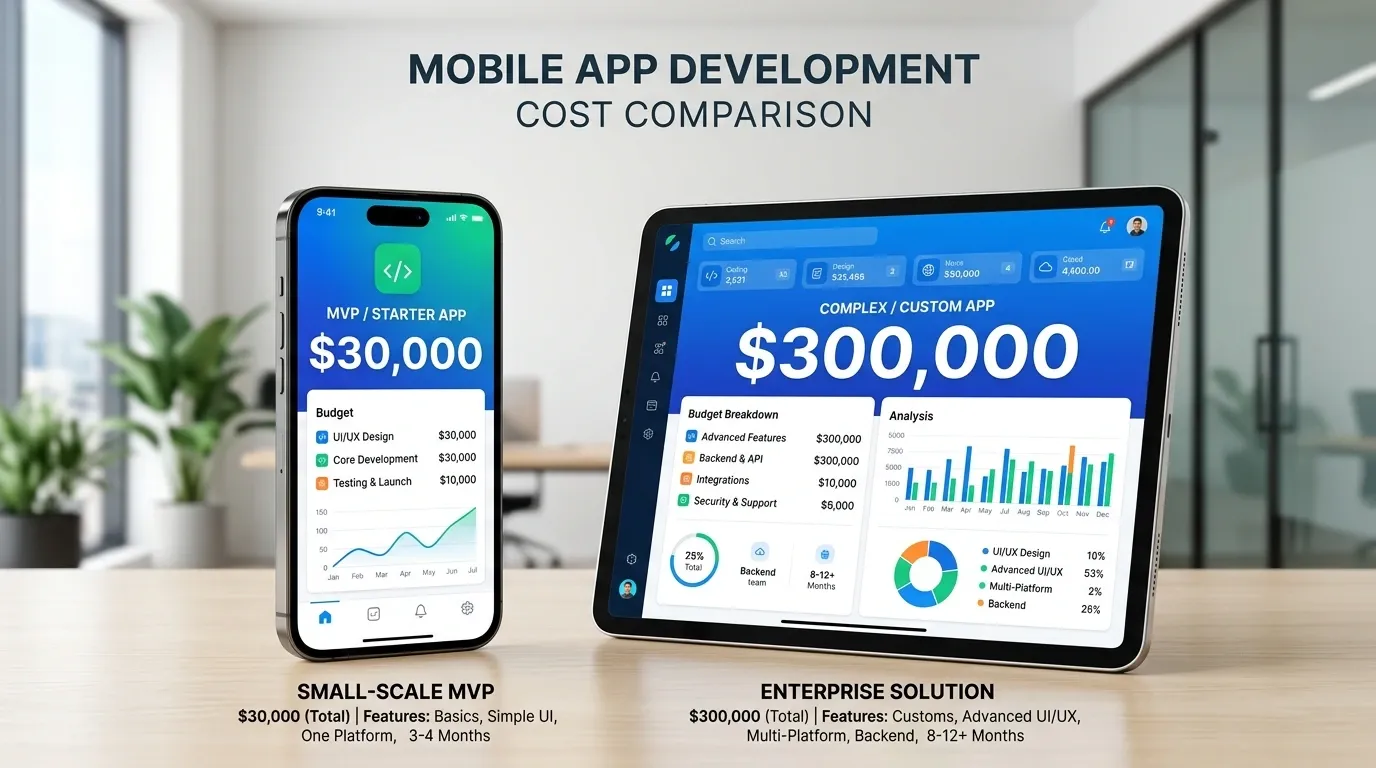
One agency says $30,000, while another says $300,000. Both can be right. This is because the final costs depend on four variables: complexity of features, platform strategy, model design, and vertical compliance requirements.
In this guide, we’ll break down exactly where those numbers come from and what you’re really paying for so your mobile app development process gets a confident start.
Get a Mobile App Cost Estimate
The Real Cost of Mobile App Development in 2026
Mobile app development cost in 2026 typically falls between $2,000 and $500,000+, depending on what you’re building.
Most small-to-mid-sized businesses land somewhere between $40,000 and $150,000 for a solid first version. Here’s how that breaks down by app tier:
| App Tier | Cost Range | Typical Timeline | Example |
| Simple / MVP | $2,000 – $25,000 | 6–10 weeks | Single-purpose app with login, basic content, simple forms |
| Mid-Complexity | $25,000 – $150,000 | 3–6 months | Business app with backend, user accounts, payment integration |
| Complex | $100,000 – $300,000 | 6–9 months | Multi-platform app with custom features, third-party APIs, advanced UX |
| Enterprise | $300,000+ | 9+ months | Large-scale platform with compliance needs, custom infrastructure, ongoing dev team |
Get Your App Development Quote
Contrary to popular beliefs, these figures aren’t pulled out from thin air – they reflect what agencies and freelance teams have been quoting across thousands of projects in 2026.
The reason your quote might sit at $40,000 while a competitor quotes $140,000 for the “same app” usually comes down to the factors we will discuss next: the complexity of the features, the platforms you’re targeting, and the cost difference between custom vs. templated designs.
Mobile App Development Cost Comparison: Top Agencies vs. Our Estimates
When you compare mobile application development cost across the top agencies, most quote $40,000–$500,000+ depending on complexity. Our estimates above start as low as $2,000 for an MVP and stay under $150,000 for most mid-complexity builds — among the lowest starting ranges compared to leading names like Appinventiv, Clarion Technologies, Simpalm, and MSM Coretech. Here’s how the numbers stack up:
| Company | Basic/MVP | Mid-Complexity | Advanced/Enterprise |
|---|---|---|---|
| Appinventiv | $40,000–$100,000 | $100,000–$200,000 | $200,000–$400,000+ |
| Clarion Technologies | $5,000–$50,000 | $50,000–$120,000 | $100,000–$300,000+ |
| Simpalm | $25,000–$75,000 | $75,000–$200,000 | $200,000–$450,000+ |
| MSM Coretech | $40,000–$80,000 | $80,000–$250,000 | $250,000–$500,000+ |
| Top Branding Altimeter | $2,000–$25,000 | $25,000–$150,000 | $100,000–$300,000+ |
Ranges reflect publicly published cost guides as of 2026. Actual project pricing depends on scope, platform, and features — request a free quote for an exact number.
What Actually Drives Mobile App Development Price Factors
Two companies can ask for “the same app” and still end up with estimates that are $10,000 apart.
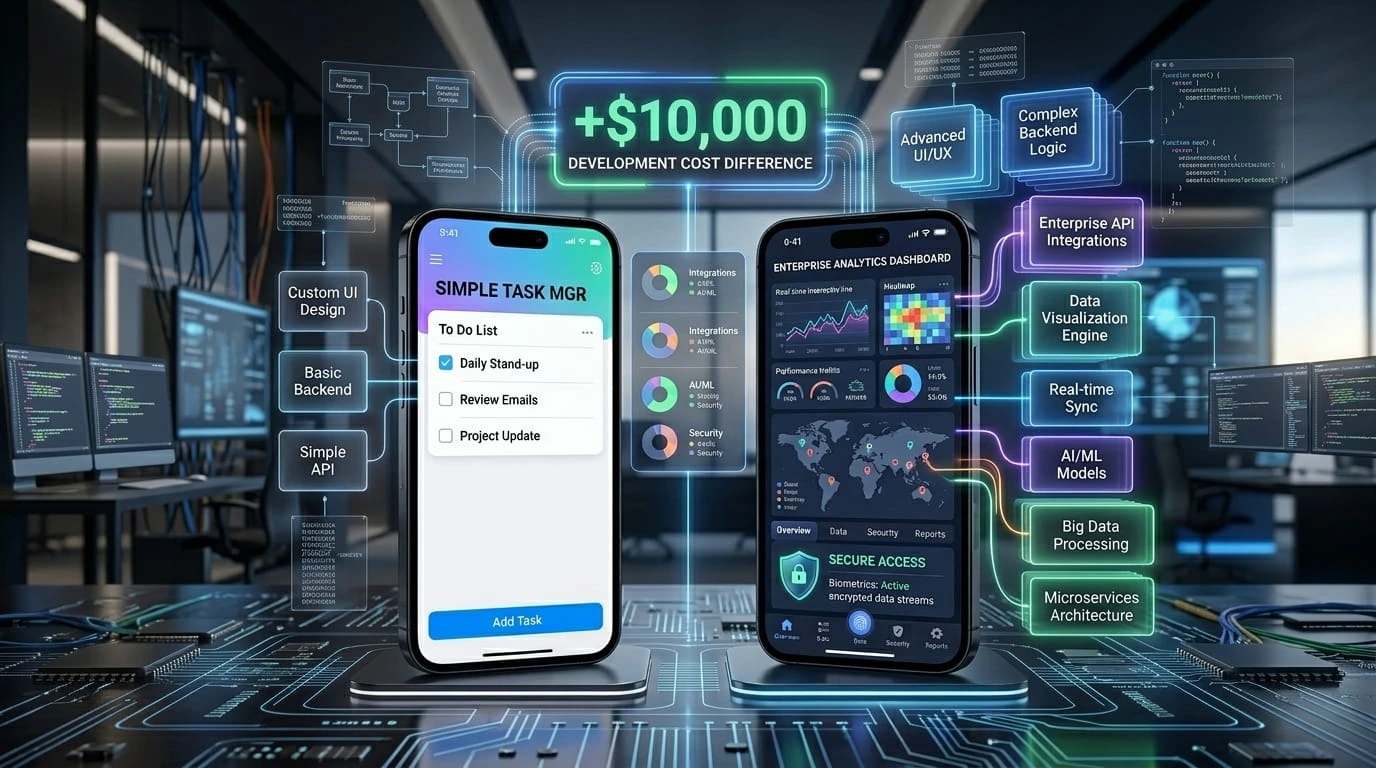
The gap isn’t agencies padding numbers or one agency charging more than the other; it’s the following factors stacking on top of each other. Here’s how:
App Complexity and Feature Count
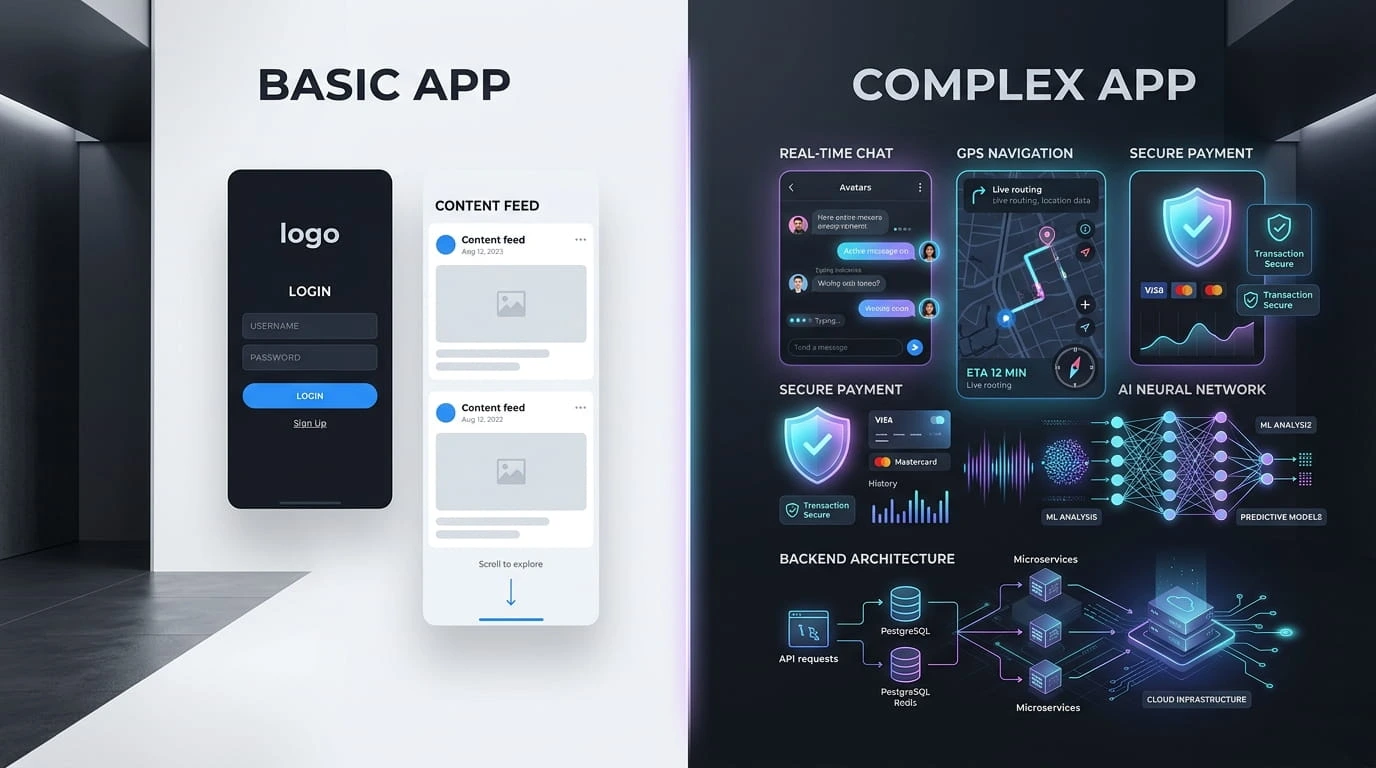
- A basic app with login, a content feed, and simple forms needs far less engineering. Hence costs less
- While a more complex one with real-time chat, GPS tracking, in-app payments, or AI-driven recommendations will cost more.
- Additional features add design hours, backend logic, testing cycles, and long-term maintenance.
Platform Choice
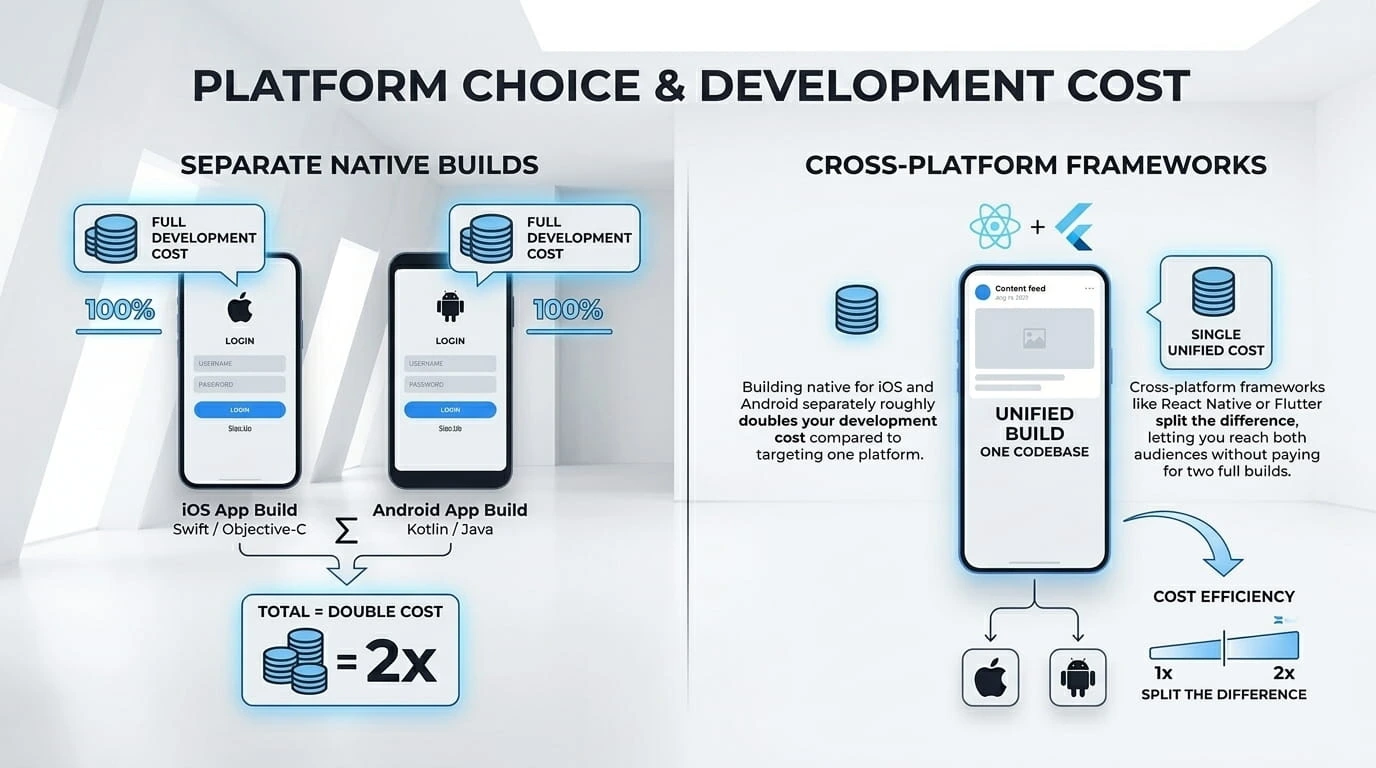
- Building native for iOS and Android separately roughly doubles your development cost compared to targeting one platform.
- Cross-platform frameworks like React Native or Flutter split the difference, letting you reach both audiences without paying for two full builds.
Design (UI/UX)
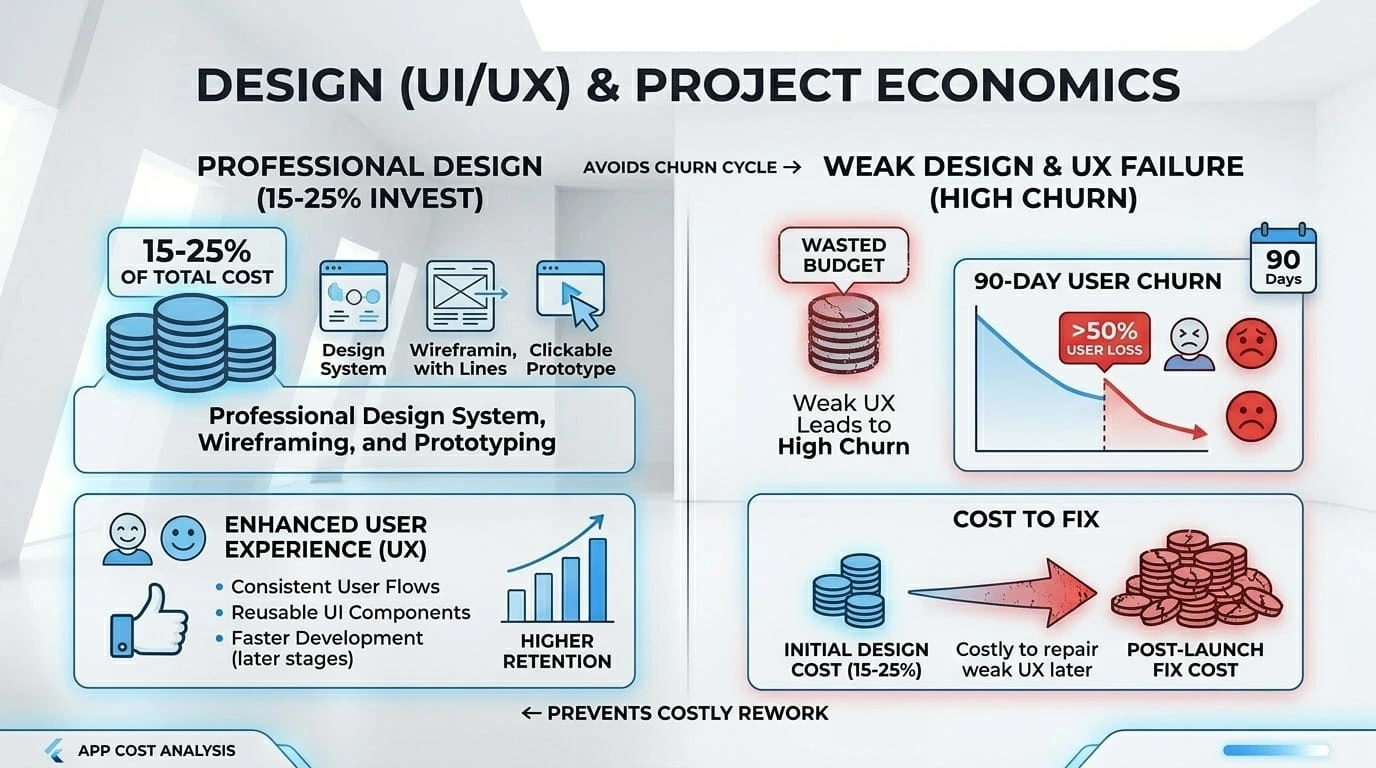
- Professional design, wireframing, prototyping, and a proper design system typically eat up 15–25% of total project cost.
- Apps with weak UX see higher churn in the first 90 days, which costs more to fix later.
Backend and Infrastructure

- Anything your app needs to store, sync, or mobile app development process.
- This includes user data, push notifications, or real-time updates.
- A simple app might run fine on cloud infrastructure for little cost.
- A data-heavy or high-traffic app, on the other hand, needs custom servers, databases, and scaling logic. Which usually costs more than designing a single screen.
Team Type and Location

- Hiring local teams costs significantly more than working with freelancers.
- A freelancer in a lower-cost region will always quote less than a full agency team.
- But this means trading off project management, QA depth, and long-term support – everything your local agency provides upfront.
Third Party Integrations

- Payment gateways, maps, analytics tools, and CRM connections require setup, error handling, testing, and ongoing maintenance as those services update on their own schedules.
- A handful of integrations can quietly add thousands to both the build and the maintenance budget.
Understanding these six factors is what turns a vague quote into a number you can actually trust, and it’s why the next agency you talk to might land nowhere near the last one.
Mobile App Cost Breakdown by Platform
Your choice of platform is one way you can move your budget up and down – sometimes by tens of thousands of dollars.
| Approach | Cost Range | Best For | Trade-off |
| iOS only | $30,000 – $250,000 | Users who spend more per app; US-heavy audiences | Smaller global reach than Android |
| Android only | $35,000 – $280,000 | Larger global user base; wider reach | Wider testing needs due to device fragmentation |
| Both, built natively | Roughly 2x a single-platform build | Performance-critical or platform-exclusive apps | Two codebases, two design passes, two QA cycles |
| Cross-platform (React Native, Flutter) | 30–50% less than building both natively | Most small-to-mid businesses wanting both platforms | Slightly less performance for graphics-heavy or hardware-deep apps |
| Web app / PWA | 20–35% less than equivalent mobile app | Lightweight, installable experience without App Store review | Limited access to device hardware (camera, sensors) |
Development in Apple’s ecosystem used to carry a cost premium due to stricter App Store review guidelines, but that gap has narrowed significantly in 2026.
The real deciding factor now is usually audience, as iOS tends to win on revenue per user, Android on total reach.
MVP vs Full App: Where Should You Start?
What an MVP actually costs: A Minimum Viable Product targeting one platform with only the core features that prove your idea works typically runs $2,000 to $60,000, with most landing in the $25,000–$60,000 range once you factor in proper design and testing.
This isn’t a stripped-down demo; it’s a real, functioning app with just enough features to get in front of users and start collecting feedback.

What a full-featured app costs: Once you move past MVP into a complete product on multiple platforms, a broader feature set, deeper backend infrastructure, and third-party integrations cost climb into the $100,000–$300,000+ range, depending on complexity.
Why starting lean usually makes more sense: Building an MVP first isn’t just about spending less upfront. It’s about spending money on the right things. An MVP lets you:
- Test whether people actually want the app before investing in every feature you imagined
- Gather real user feedback that shapes what the full version should include (instead of guessing)
- Catch UX problems early, when they’re cheap to fix, rather than after a full build
- Spread your investment across stages instead of committing your entire budget before you know if the idea works
The businesses that skip this step and go straight to a fully-loaded build often end up rebuilding core features anyway once real users show them what actually matters, which costs more than starting lean would have.
When it makes sense to skip the MVP stage: If you already have strong market validation (an existing customer base asking for the app, a proven business model you’re digitizing, or a hard deadline tied to a launch), building the fuller version from the start can be the right call.
Launch Your MVP for Less
Validate your app idea affordably before committing to a full build.
The MVP-first approach is a default for uncertainty, not a rule for every business.
Freelancer vs. Agency

Choosing whether to partner with a trusted agency or hire a freelancer significantly affects your total cost
What Freelancers Typically Charge: Freelance developers generally quote lower rates, and for simple, well-defined apps, that can mean real savings.
You’re paying for hands-on coding time without the overhead of a full team, project managers, or a dedicated QA process.
What agencies typically charge: Agencies cost more, but that premium usually buys you a full team — designers, developers, QA testers, and a project manager working in parallel rather than one person handling everything sequentially.
It also buys structure: defined timelines, documented processes, and accountability if something goes wrong.
How to decide
If your app is simple, your timeline is flexible, and you’re comfortable managing the process yourself, a skilled freelancer can get you a solid MVP for meaningfully less.
If your app is complex, time-sensitive, or something you’ll need ongoing support for after launch, an agency’s structure is usually worth the premium, not because freelancers can’t do good work, but because the risk of things falling apart mid-project goes down significantly with a team behind you.
Talk to an App Development Team
Hidden Mobile App Development Costs Nobody Warns You About

The quote you get for building your app is rarely the full picture. Here’s what tends to show up after launch and catches businesses off guard.
Ongoing maintenance: Budget 15–25% of your initial development cost every year to keep the app running.
This covers OS updates from Apple and Google, bug fixes, security patches, and performance monitoring.
Many businesses see this spike closer to 50% in year one, once real users surface issues testing never caught.
- App Store fees: Apple charges a $99/year developer fee; Google charges a one-time $25 fee for a Play Store account. Small on their own, but easy to omit from an initial quote.
- Third-party API and service costs: Payment processors, mapping tools, analytics platforms, and cloud hosting typically charge ongoing, usage-based fees rather than a one-time cost. As your user base grows, so does this bill.
- Post-launch feature requests: Real usage almost always surfaces features you didn’t know you needed. Budgeting for a few rounds of post-launch iteration keeps the app competitive instead of stagnant.
- Design and UX revisions: Usage data tends to reveal friction points that weren’t obvious during testing. Revisiting key flows a few months after launch is a cost most budgets don’t plan for.
- Server and infrastructure scaling: An app built for 500 users doesn’t automatically handle 50,000. Faster-than-expected growth means backend scaling becomes its own line item.
Why this matters for your budget: none of these costs are optional if you want your app to stay functional and secure long-term; they’re just often left out of the initial pitch.
A realistic first-year budget adds roughly 15–25% on top of your build quote, not treats that quote as the finish line.
Get a Quote With No Hidden Costs
See a transparent breakdown covering build, launch, and maintenance.
How to Reduce App Development Cost Without Cutting Corners

- Start with an MVP: Launch with core features only, then expand based on real user feedback instead of guessing upfront.
- Go cross-platform: React Native or Flutter can cut costs 30–50% versus building separate native apps.
- Nail down scope before development starts: A clear discovery phase prevents expensive mid-project changes.
- Prioritize features: Build what users need first; save “nice-to-have” features for a later update.
- Choose the right team for the job: A freelancer for a simple MVP, an agency for something complex or time-sensitive.
- Reuse existing tools where possible: Third-party SDKs and APIs (payments, auth, analytics) are often cheaper than building custom.
The goal isn’t the cheapest possible app; it’s spending money on what actually moves the product forward, and cutting what doesn’t.
Getting an Accurate App Development Quote

A trustworthy quote should break down cost by phase (design, development, QA, deployment), clarify what platform(s) are included, and state what happens after launch; maintenance isn’t optional, so it shouldn’t be a surprise later.
Online app cost estimators can give you a rough starting number, but they can’t account for your specific features or industry requirements.
Use them to sanity-check a quote, not to replace one. If a quote seems dramatically lower than everything else you’ve seen, ask what’s missing; usually it’s maintenance, QA, or post-launch support.
Get an Accurate, Honest App Quote
Compare pricing with a team backed by 700+ Google reviews.
FAQs – mobile app development cost
How much does it cost to build a mobile app in 2026?
Most apps cost between $15,000 and $500,000+, depending on complexity, platform, and features. Small-to-mid businesses typically spend $40,000–$150,000 for a solid first version.
What factors affect mobile app development cost the most?
Feature complexity, platform choice, design quality, and team type (freelancer vs. agency) are the biggest cost drivers. Backend infrastructure and third-party integrations also add high cost as they scale.
Is it cheaper to build an Android app or an iOS app first?
iOS apps generally run $30,000–$250,000, while Android apps run $35,000–$280,000, so the difference is smaller than most expect.
How much does an MVP app cost compared to a full app?
An MVP typically costs $2,000–$60,000, while a full-featured app runs $100,000–$300,000+. Starting with an MVP lets you validate the idea before committing to the larger build.
What ongoing costs come after the app is launched?
Expect to spend 15–25% of your build cost annually on maintenance, plus App Store fees and third-party API costs. First-year costs often run higher as real user feedback surfaces fixes and improvements.
Does a hybrid app really cost less than a native app?
Yes, cross-platform frameworks like React Native or Flutter cost 30–50% less than building separate native apps for iOS and Android.
How do agencies price app development projects?
Agencies typically price by project phase: design, development, QA, and deployment, factoring in team size and timeline.
Can a small business afford custom app development?
Yes, especially by starting with an MVP instead of a full-featured build. A lean, well-scoped MVP can cost as little as $2,000–$25,000 and still deliver a functional, testable product.
Mobile app development price in 2026 is a range shaped by complexity, platform, design, and who builds it.
Start with a clear scope, pick the right team for your budget and risk tolerance, and plan for maintenance from day one instead of after launch. Get those pieces right, and your next quote won’t feel like a guess.
Top Branding Altimeter offers affordable mobile app development with 700+ Google reviews you can trust. Compare pricing and get a low-cost app quote.
Ready to Grow Your Business?
Get expert guidance tailored to your brand — completely free consultation
Get Free Consultation