
- Local SEO for Small Business: Best Ranking Guide 2026-27
- Understanding Local Search (The Basics)
- Core Local SEO Ranking Factors
- Step-by-Step Local SEO Optimization Guide (Steps 1–2)
- Is Your Google Business Profile Fully Optimized?
- Practical Toolkit & Maintenance
- How to Conduct a Local SEO Audit
- Critical Mistakes to Avoid
- Not Sure Where Your Local Rankings Stand?
- Frequently Asked Questions
- Conclusion
Local SEO for Small Business: Best Ranking Guide 2026-27
Local SEO for Small Business is the process of optimizing your Google Business Profile, citations, and reviews to rank in the map 3-pack — Top Branding Altimeter breaks down the exact steps here.
If you run a local business, you already know the struggle. You offer a great service; your current customers love you, but finding new ones feels like a constant uphill battle.
Why? Because when people in your town need what you sell, they don’t pull out a phone book. They pull out their smartphones and type “best [service] near me.”
If your business doesn’t show up in those top three map results on Google, you might as well be invisible. That’s where local SEO for small businesses comes in.
In this best local seo services for small business recent optimization guide, we’re breaking down the exact, step-by-step process to get your business seen by nearby customers who are ready to buy right now. We’ll cover everything from getting your Google Business Profile to shine to building an unbeatable review strategy and tracking your progress on a realistic local SEO results timeline.
Understanding Local Search (The Basics)
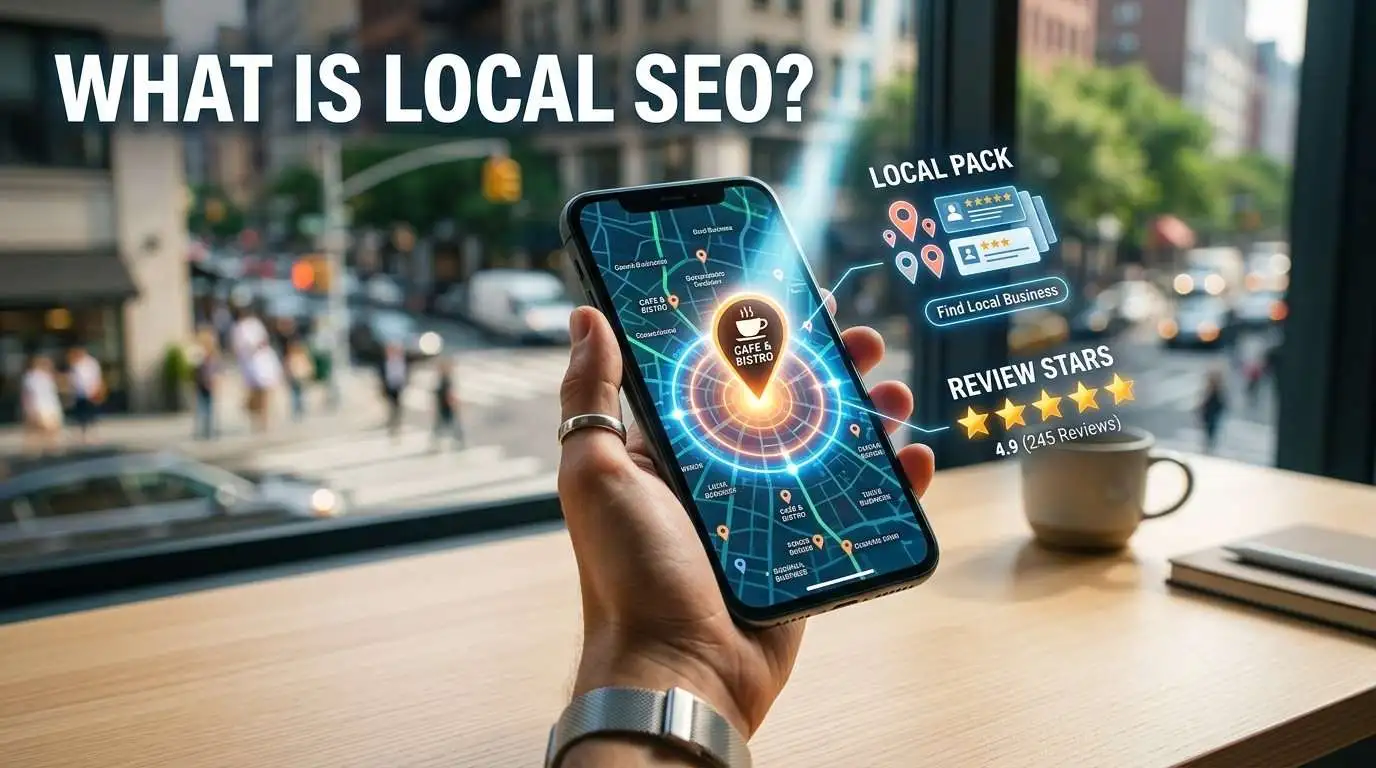
What Is Local Search Engine Optimization?
Local SEO is the practice of optimizing your online presence so your business shows up when nearby customers search for what you offer.
Instead of competing for broad, national visibility, you’re competing for visibility within a specific geographic radius – your city, your neighborhood, sometimes just a few miles from your front door.
Local SEO vs. National SEO
The two disciplines share a foundation but diverge sharply in execution:
| Factor | Local SEO | National SEO |
| Target audience | Nearby customers with immediate intent | Broad, geographically dispersed audience |
| Primary ranking signals | Google Business Profile, citations, proximity | Domain authority, backlinks, content depth |
| Search intent | “Near me,” service + city | Informational, broad commercial |
| Key platforms | Google Maps, local pack, GBP | Organic search results, national directories |
Search intent is the real dividing line. Someone typing “plumber near me” wants a phone number in the next five minutes.
Someone typing “best plumbing fixtures 2026” wants information, not necessarily a business down the street.
How Small Businesses Rank in Local Search
Google’s local algorithm leans on three core mechanisms: how physically close your business is to the searcher, how relevant your listing is to their query, and how established and trustworthy your business appears based on reviews, citations, and overall web presence.
The Map Pack Demystified
The “Local 3-Pack” is the block of three business listings complete with map, star ratings, and contact info that appears above traditional organic results for local queries.
It’s prime real estate: high visibility, high click-through, and it’s what most local searches are actually trying to reach.
Three factors decide who lands in it:
- Proximity: how close the business is to the searcher (or the searched location)
- Relevance: how well the business profile matches the search query
- Prominence: how well-known and reputable the business is, based on reviews, links, and citations
Core Local SEO Ranking Factors

Ranking in local search isn’t decided by one factor; it’s a combination of signals working together. Here’s what actually moves the needle.
Primary Ranking Drivers
- Google Business Profile (GBP) optimization signal strength: Your GBP is the single most influential factor in local rankings. A complete, accurate, and actively managed profile tells Google (and customers) that your business is legitimate and relevant.
- On-page signals: This includes NAP (Name, Address, Phone) parity between your website and your GBP, local keywords woven naturally into your content, and dedicated landing pages for each service area you cover.
- Off-page signals: Local citations for small business listings (mentions of your NAP across the web), local link building from community sites and local press, and overall domain authority.
- Review & behavioral signals: Click-through rates from search results, check-ins, the volume and recency of customer reviews, and your average star rating all factor into how Google judges your prominence.
| Signal Category | Examples | Why It Matters |
| On-page | NAP consistency, local keywords, service pages | Confirms relevance to searcher’s location and need |
| Off-page | Citations, backlinks, domain authority | Builds trust and authority signals |
| Review/Behavioral | Star ratings, review volume, CTR | Signals prominence and real-world credibility |
| GBP | Categories, photos, posts, Q&A | Directly powers map pack visibility |
No signal can carry a local business on top of the map pack by itself – it’s a combination that Google rewards.
Step-by-Step Local SEO Optimization Guide (Steps 1–2)
Step 1: Claim & Optimize Your Google Business Profile
Your Google Business Profile (GBP) is the foundation of local visibility. Get this wrong, and everything else struggles to compensate.
Google Business Profile optimization steps SEO for small local businesses

- Claim and verify your listing: unclaimed profiles rank poorly and can be edited by anyone.
- Choose the right primary category: this single setting influences which searches you show up for more than almost anything else on the profile.
- Add accurate business hours: this also includes holiday hours, so customers (and Google) trust the listing is actively maintained.
- List your services in detail: vague listings blend in; specific ones match more search queries.
- Upload high-quality images: interior, exterior, team, and product/service photos. Profiles with photos get significantly more engagement than those without.
- Write an optimized business description: naturally include your core service and location without keyword-stuffing.
- Post regularly: GBP posts (offers, updates, events) signal an active, well-maintained business.
Step 2: Master Local SEO Keyword Research

Generic keyword research misses the point of local SEO. You’re not just looking for volume; you’re looking for geo-targeted, high-intent phrases your actual customers use.
Start with “service + location” combinations: e.g., “emergency plumber Cleveland” rather than just “plumber.”
Mine Google’s autocomplete and “People also ask”: Use those for real local search patterns.
Check competitor GBP listings and websites: see which local terms they’re already ranking for.
Map each keyword to a specific page: don’t try to rank one homepage for every service and every neighborhood.
Assign:
- Core service keywords → dedicated service pages
- Location-based variants → location-specific landing pages
- Broad brand terms → homepage
Step 3: On-Page Optimization for Local Intent
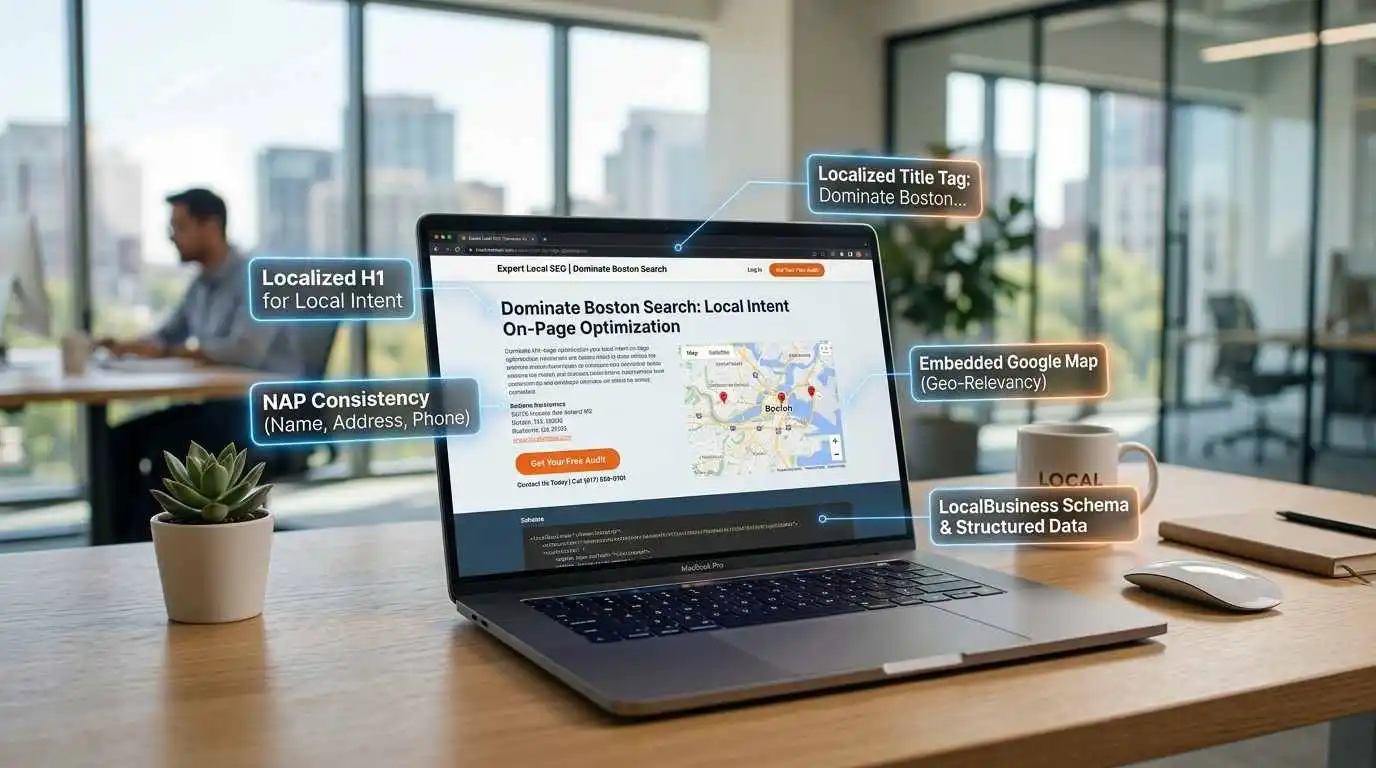
Once your keywords are mapped, the next job is making sure your actual pages send the right local signals to both search engines and visitors.
- Craft localized title tags and meta descriptions: work the city or service area naturally into the title (e.g., “Residential Roofing Services in Cleveland, OH | [Business Name]”) rather than tacking it on awkwardly.
- Structure headers with local intent in mind: your H1 should clearly state the service and location; H2s can break out specific offerings, service areas, or FAQs.
- Embed a Google Map on your contact or location page: this reinforces your address and gives visitors (and Google) a clear geographic signal.
- Add LocalBusiness schema markup: structured data that explicitly tells search engines your business name, address, phone number, hours, and service area in a format they can parse directly.
- Maintain consistent NAP across every page: even small formatting differences (e.g., “St.” vs. “Street”) can create inconsistency signals.
Step 4: Build & Audit Local Citations

A citation is any online mention of your business’s Name, Address, and Phone number — whether or not it links back to your site. Citations are one of the strongest off-page trust signals in local SEO.
- Your local citations and why they matter: Google cross-references citations across the web to confirm your business is real, active, and located where you say it is. Inconsistent NAP across citations actively hurts rankings.
- Prioritize the major directories: Yelp, YellowPages, Bing Places, Apple Maps, and industry-specific directories relevant to your business type.
- Audit for duplicates and inconsistencies: duplicate listings (often created accidentally through past ownership changes or third-party data aggregators) confuse Google and dilute your prominence signals.
- Standardize your NAP format: Do this before submitting new citations, and update any existing ones that don’t match.
Step 5: Execute a Local SEO Review Strategy
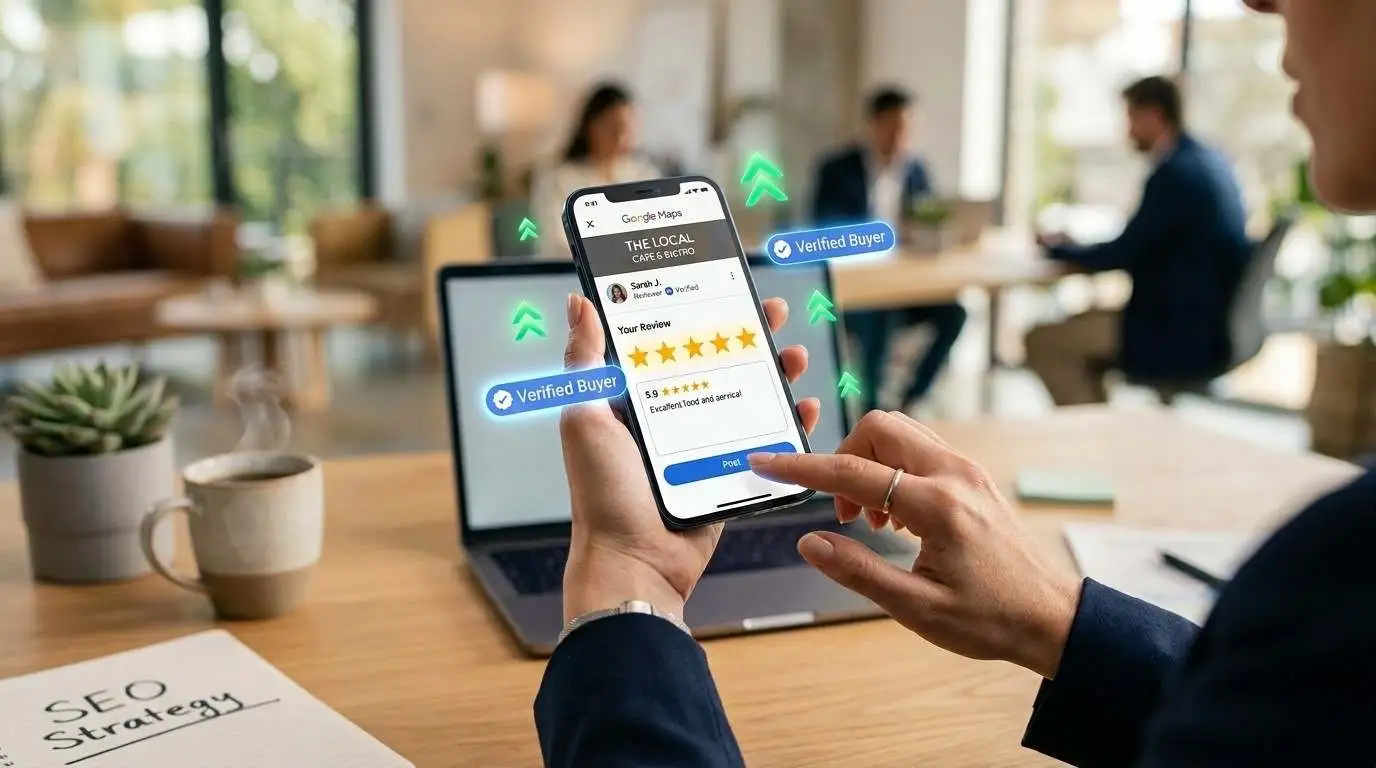
Reviews are one of the most visible trust signals to both Google and potential customers, and one of the easiest to neglect.
- Generate reviews systematically: build a simple ask into your workflow (post-service follow-up email, receipt insert, or text message) rather than hoping customers remember on their own.
- Make it easy: a direct link to your GBP review form removes friction and meaningfully increases response rates.
- Respond to every review, positive and negative: Google factors response activity into prominence, and public replies signal to future customers that you’re engaged and accountable.
- Handle negative reviews professionally: acknowledge the concern, keep it brief, and move the conversation offline when needed. Defensive or dismissive replies do more damage than the original review.
- Never buy or incentivize fake reviews: this violates Google’s policies and risks profile suspension, which erases all your accumulated prominence signals overnight.
Step 6: Strategy for Scaling (Multi-Location Businesses)

Local SEO for multi-location business entities requires a different structure than a single-location strategy.
This is mainly because you’re now optimizing for several distinct geographic areas at once, without competing against yourself.
- Create a separate landing page for each location: each page should target that specific city/neighborhood with unique content, not a copy-pasted template with the city name swapped out.
- Set up location-specific GBP listings: each one needs its own verification, hours, photos, and review management.
- Avoid duplicate content penalties: do this by writing genuinely unique descriptions, service details, and local context (nearby landmarks, service area specifics, location-specific testimonials) for every page
- Use consistent site-wide navigation: so users (and Google) can easily find and move between location pages — a location selector or dedicated “Locations” page works well.
- Keep NAP consistent per location: each location page’s schema markup and citations should match that specific address exactly.
Is Your Google Business Profile Fully Optimized?
Get expert guidance tailored to your brand — a completely free consultation
Practical Toolkit & Maintenance
Quick-Reference Checklist
- GBP fully claimed, verified, and complete, including categories, hours, and services
- NAP consistent across your website, GBP, and every citation
- Local schema markup implemented on key pages
- Reviews actively requested after every job and responded to promptly
- Location pages unique and current (if multi-location)
- Site loads fast and displays cleanly on mobile
Actionable Tips for Quick Wins
- Add service-area keywords naturally into page titles and headers
- Build a simple review-request step into your post-service workflow
- Search your own business name to catch and fix duplicate GBP listings
- Add a few recent, high-quality photos to your GBP monthly to keep it active
How to Conduct a Local SEO Audit
A basic audit needs to be consistent. Check four areas on a regular schedule: GBP completeness (categories, photos, posts), citation consistency (NAP matches everywhere), on-page local signals (schema, localized titles, embedded map), and review activity (volume, recency, response rate).
Flag any gaps in each area before layering on new tactics – fixing foundational issues first makes everything built on top of them more effective.
Critical Mistakes to Avoid
- Inconsistent NAP formatting across directories (e.g., “St.” vs. “Street”)
- Fake or incentivized reviews, which risk profile suspension
- Choosing the wrong primary GBP category, which quietly limits which searches you show up for
- Ignoring mobile page speed, since most local searches happen on phones.
Not Sure Where Your Local Rankings Stand?
Get expert guidance tailored to your brand — a completely free consultation
Frequently Asked Questions
How much does local SEO cost for a small business?
Local SEO typically costs $299–$1,299/month depending on market competition and service scope; Top Branding Altimeter builds custom pricing based on your business size and goals.
Does AI help with local SEO for small businesses?
Yes — AI speeds up keyword research, content generation, and rank tracking, but strategic execution from experts like Top Branding Altimeter is what actually converts that data into local rankings.
How does hyper-local SEO work for small businesses?
Hyper-local SEO targets specific neighborhoods or zip codes using geo-targeted keywords and localized landing pages, helping nearby high-intent customers find you first — a core service at Top Branding Altimeter.
What are the best local SEO strategies for small businesses?
The top strategies are an optimized Google Business Profile, consistent NAP citations, active review generation, and location-specific content — the exact framework TBA uses for client campaigns.
What is local SEO and why does it matter for small businesses?
It’s the practice of optimizing your online presence to rank for local searches, which is critical for businesses that rely on local foot traffic or service calls.
How do I optimize my Google Business Profile?
Claim it, choose the right category, complete every field, add photos, and post updates regularly.
What are local citations and why do they matter?
Mentions of your NAP across the web that confirm your business’s legitimacy and location to Google.
How many reviews does a business need to rank in the local pack?
There’s no fixed number – consistent, recent reviews matter more than hitting a specific count.
How is local SEO different from regular SEO?
Local SEO targets nearby, high-intent searchers; national SEO targets broader audiences and informational intent.
What’s the biggest local SEO mistake small businesses make?
Inconsistent NAP information across their website and directory listings.
How long does local SEO take to show results?
Most businesses see meaningful movement within 3–6 months of consistent effort.
Do multi-location businesses need separate SEO pages?
Yes, each location needs its own unique landing page and GBP listing.
Conclusion
Local SEO is an ongoing system of GBP management, on-page signals, citations, and reviews working together. Businesses that treat it as a consistent practice, not a quick project, are the ones that dominate the map pack in the long term.
Ready to see where your business stands? Start with a local SEO audit, or let Top Branding Altimeter, the best local SEO company for small business, build and manage your strategy for you.
Ready to Grow Your Business?
Get expert guidance tailored to your brand — completely free consultation
Get Free Consultation