- What Makes Good HVAC Web Design? Full 2026 Guide
- What Is HVAC Web Design?
- What Makes a Good HVAC Website?
- Essential Features of an HVAC Website
- How HVAC Web Design Improves User Experience
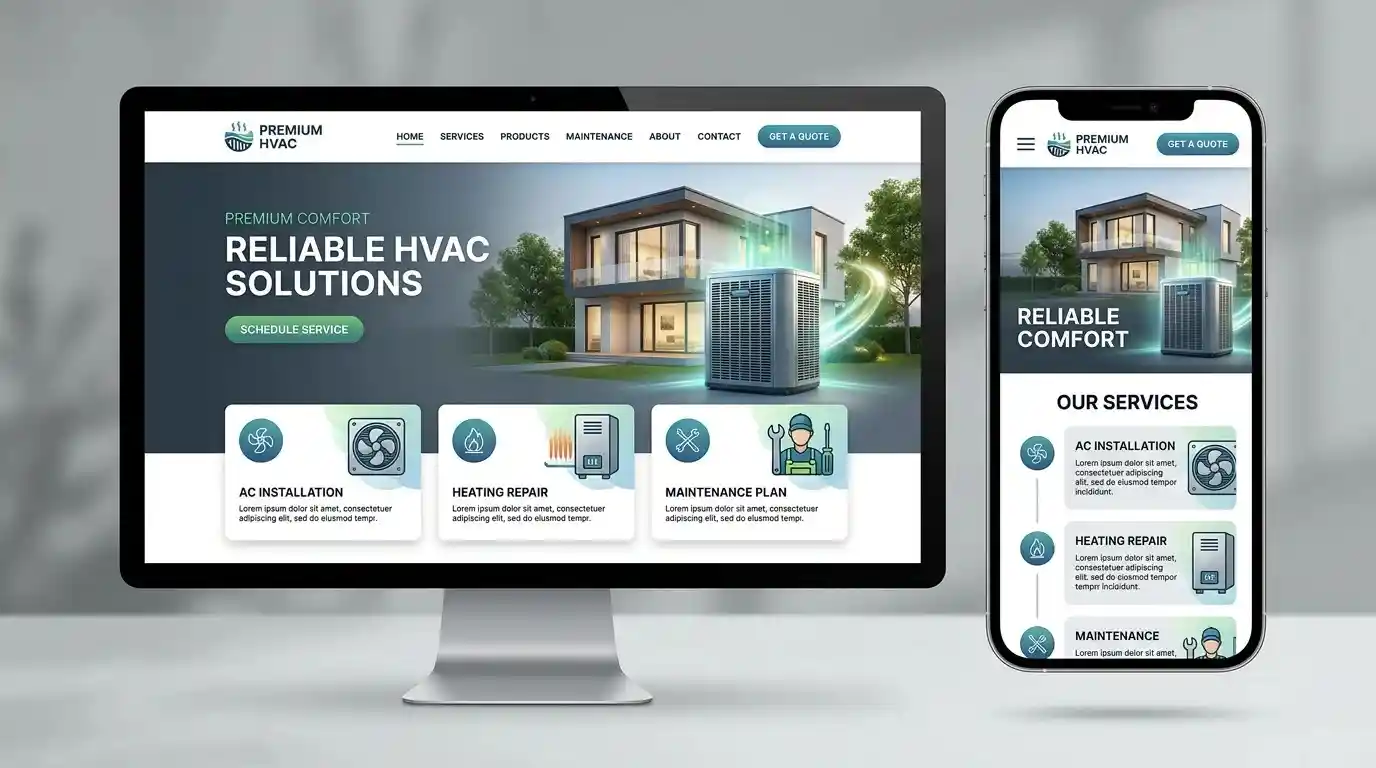
- Mobile-First HVAC Website Design
- HVAC Website SEO Best Practices
- Common HVAC Website Problems and How to Fix Them
- HVAC Website Design Examples and What They Get Right
- Custom HVAC Website vs Template
- HVAC Website Builder vs Custom Development
- How Much Does an HVAC Website Cost?
- How to Evaluate an HVAC Website
- When Should an HVAC Company Redesign Its Website?
- HVAC Website Design Checklist
- Frequently Asked Questions About HVAC Web Design
- Ready to Fix Your HVAC Website?
What Makes Good HVAC Web Design? Full 2026 Guide
Not sure if your HVAC website is working against you? Learn the key features, common problems, and how to evaluate it — no sales pitch.
If your HVAC website isn’t bringing in calls, the problem is usually design, not demand. Homeowners are searching for AC repair and furnace service every single day — the question is whether your site can turn that traffic into booked jobs.
This guide breaks down what HVAC web design actually means, what a good HVAC website needs, and how to spot (and fix) the problems that quietly cost contractors leads.
What Is HVAC Web Design?
HVAC web design is the process of planning, structuring, and building a website specifically for heating and cooling businesses — one that reflects how HVAC customers actually search, compare, and decide.
It’s different from general web design because HVAC has its own rhythm: emergency calls, seasonal demand swings, service-area coverage, and trust-heavy decisions (people are letting a stranger into their home). A good HVAC website accounts for all of that in its layout, content, and navigation — not just its visuals.
Generic templates built for restaurants or retail shops don’t account for any of this, which is why so many HVAC sites look fine but still underperform.
What Makes a Good HVAC Website?
A strong HVAC website consistently does a few things well:
- Clear navigation — visitors find AC repair, heating, or maintenance info in one or two clicks
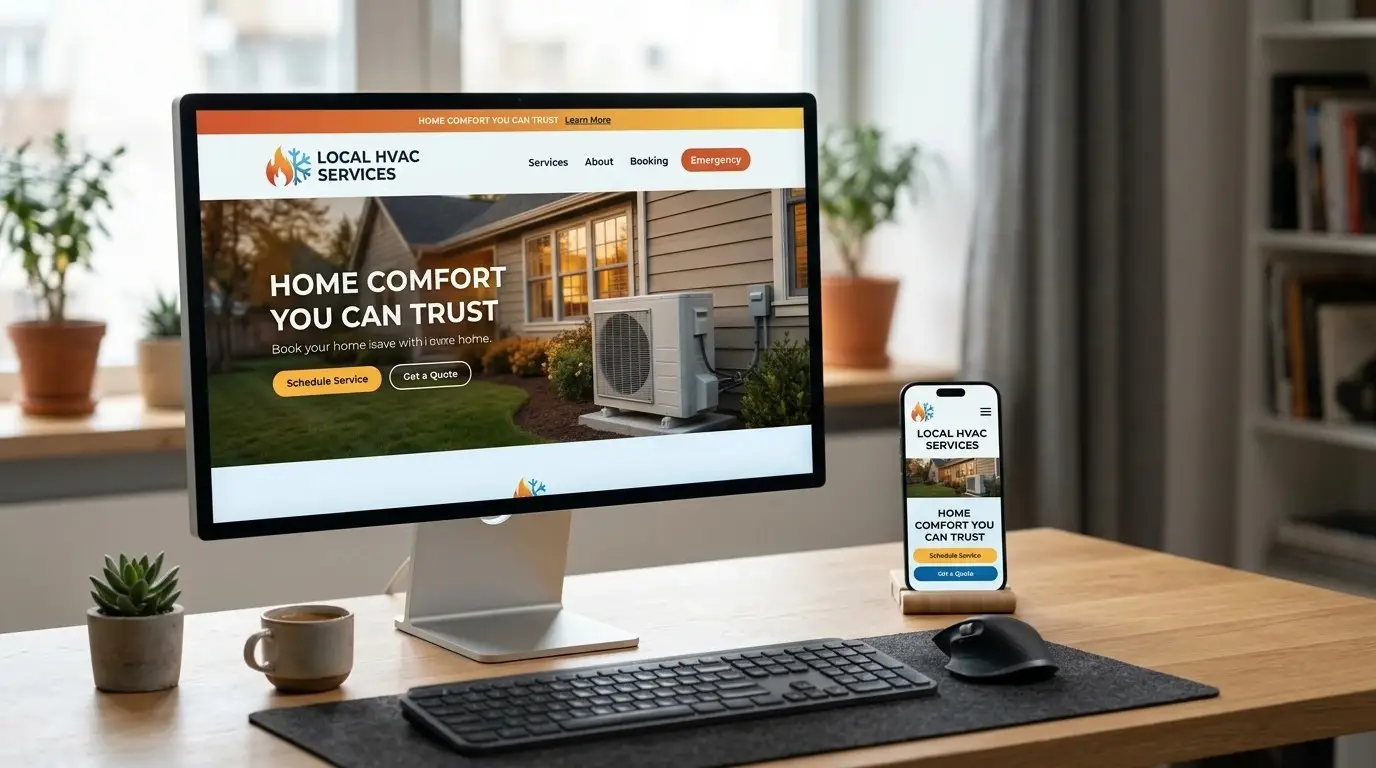
- Mobile-first experience — most HVAC searches happen on a phone, often during a problem
- Fast loading — slow pages lose emergency visitors within seconds
- Obvious contact options — click-to-call, a request form, or booking, always visible
- Trust signals — reviews, licensing, years in business, and real technician photos
- Local relevance — content that reflects the actual service area, not a copy-pasted template
None of these require flashy design. They require the site to be built around how a stressed, time-pressed homeowner actually behaves.
Essential Features of an HVAC Website
At minimum, an HVAC website should include:
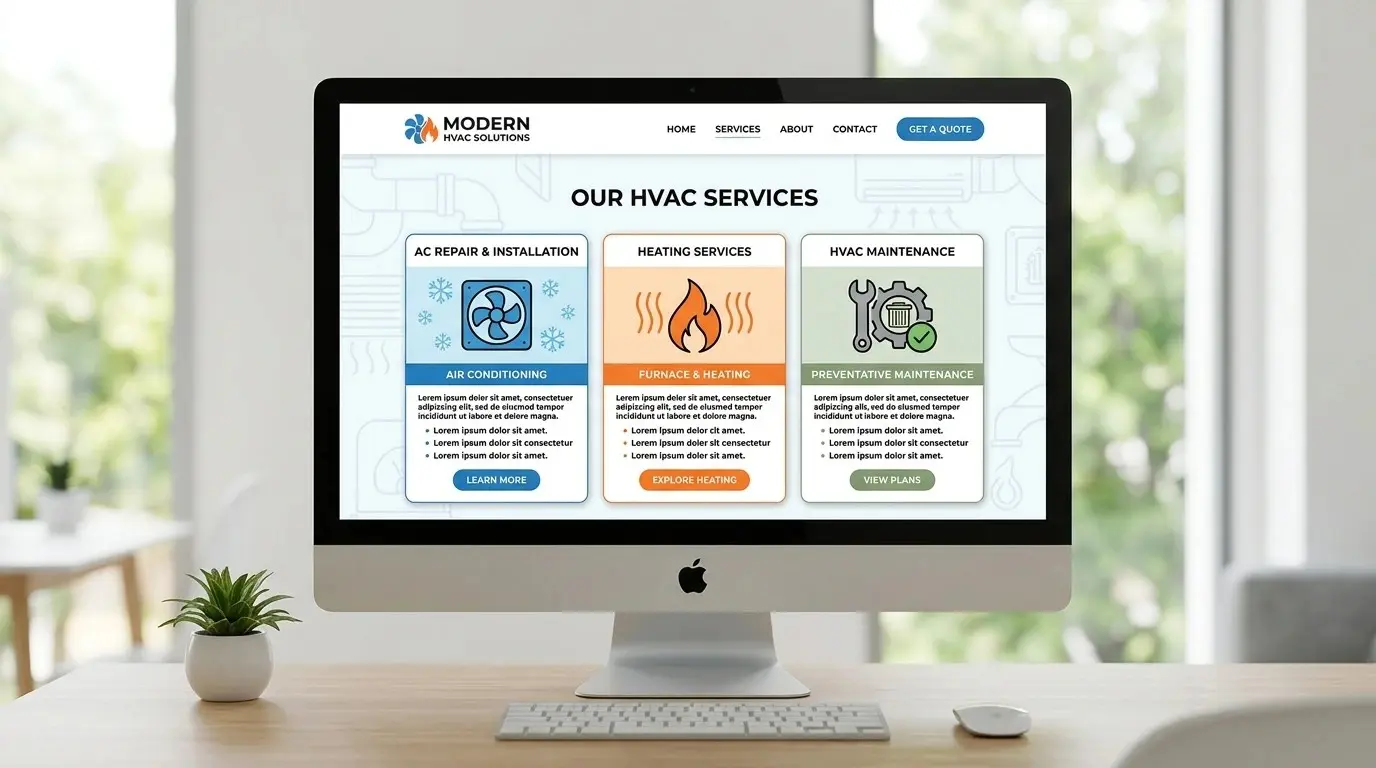
- Individual service pages (AC repair, AC installation, heating, furnace repair, furnace installation, maintenance plans, indoor air quality)
- Emergency HVAC information, clearly separated from routine service
- Service-area pages that reflect real local coverage
- Click-to-call buttons on every page, especially mobile
- A simple quote or request-service form
- Online scheduling or booking, if the business supports it
- Reviews and ratings, ideally pulled in live rather than screenshotted
- Financing information, since HVAC replacements are a significant expense
- Warranty and guarantee details
- Technician or company background (licensing, insurance, years in business)
- An FAQ section addressing common HVAC concerns
- Clear, current contact information (phone, address, hours)
How HVAC Web Design Improves User Experience
Good HVAC web design reduces the number of decisions a visitor has to make before contacting you.
That comes down to information architecture — organizing pages so someone with a broken furnace, and someone planning a new install, both land on relevant content within seconds. Visual hierarchy matters here too: headlines, phone numbers, and CTAs should stand out immediately, without the visitor scanning the whole page.
Friction is the real enemy. Long forms, buried phone numbers, and unclear service descriptions all push visitors back to the search results — usually toward a competitor.
Mobile-First HVAC Website Design
Most HVAC searches happen on a phone, frequently from someone standing next to a broken unit. A mobile-first HVAC website should have:
- Responsive layouts that adapt cleanly, not just shrink
- A sticky or easily reachable click-to-call button
- Mobile-friendly booking and contact forms (short, thumb-friendly)
- Fast load times, since HVAC visitors rarely wait
- Readable text without pinching or zooming
If your site was designed desktop-first and “made responsive” afterward, it’s usually the mobile experience that breaks down first.
HVAC Website SEO Best Practices
Website design and SEO are more connected than most HVAC owners realize. A well-structured HVAC website supports:
- Website architecture — logical service and location pages, not one crowded homepage
- Internal linking — connecting related service and location pages to spread authority
- Title and meta basics — clear, descriptive, and specific to each page
- Image optimization — compressed images with descriptive file names and alt text
- Page speed — a direct ranking and conversion factor
- Mobile SEO — since most local HVAC searches are mobile
- Local SEO — consistent NAP (name, address, phone) and Google Business Profile alignment
- Structured data — schema markup that helps search engines and AI tools understand your services
- Helpful, original content — genuinely useful pages, not thin, duplicated location pages
This isn’t a separate service you bolt on later — it’s baked into how the website is built from the start.
Get an SEO-Ready HVAC Website
Build a site that ranks locally from day one, not as an afterthought.
Common HVAC Website Problems and How to Fix Them
| Problem | Why It Hurts | Fix |
|---|---|---|
| Outdated design | Signals an inactive or unreliable business | Refresh design and content on a modern platform |
| Slow page speed | Visitors leave before the page loads | Optimize images, hosting, and code |
| Poor mobile experience | Most traffic is mobile — this is often the biggest leak | Rebuild with a true mobile-first layout |
| Confusing navigation | Visitors can’t find the service they need | Simplify menus around core services |
| Weak or hidden CTAs | Visitors don’t know how to contact you | Add clear, repeated calls-to-action |
| Missing service details | Visitors leave to find clearer information | Build out complete, specific service pages |
| Weak trust signals | Visitors hesitate to book | Add reviews, licensing, and real photos |
| Thin or duplicate location pages | Poor local search visibility | Write unique, locally relevant content per area |
| Difficult contact/booking process | Lost leads at the final step | Shorten forms, add click-to-call and scheduling |
This is usually the single most valuable exercise an HVAC owner can do: audit the site against this list before deciding what to fix.
Free HVAC Website Audit
Find out exactly what’s costing you leads — get a free site review.
HVAC Website Design Examples and What They Get Right
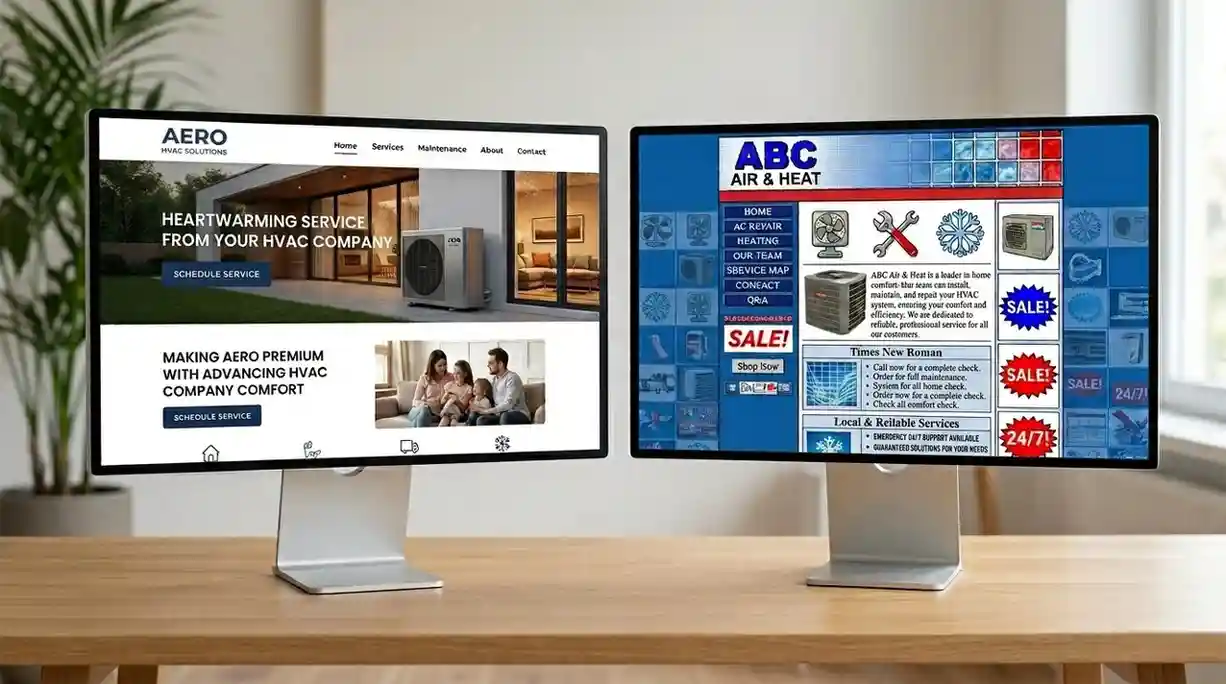
Rather than just listing examples, it’s more useful to look at why certain HVAC websites convert better than others.
The HVAC sites that perform well tend to share a few traits: the phone number is visible without scrolling, the homepage leads with services (not a generic “Welcome to our company” message), and service-area coverage is stated clearly instead of implied. Emergency service, if offered, is usually called out near the top of the page — not buried in a footer link.
What underperforming sites get wrong is almost always the same: generic stock photography that could belong to any business, service descriptions copied from a template, and a contact process that requires too many steps. The lesson isn’t to copy a specific competitor — it’s to remove friction and generic messaging wherever it appears.
Custom HVAC Website vs Template
| Factor | Custom Website | Template Website |
|---|---|---|
| Branding | Fully tailored to the company | Limited, often shared with competitors |
| SEO control | Full control over structure and code | Restricted by template limitations |
| Scalability | Easy to expand as the business grows | Harder to scale past template constraints |
| User experience | Built around actual customer behavior | Generic, one-size-fits-all layout |
| Cost | Higher upfront investment | Lower upfront cost |
| Maintenance | Ongoing, but flexible | Simple, but limited |
Neither option is universally “better.” A template can work for a smaller HVAC business with a tight budget; a custom build makes sense once lead volume, service-area complexity, or SEO goals outgrow what a template can support.
HVAC Website Builder vs Custom Development
| Factor | Website Builder | Custom Development |
|---|---|---|
| Ease of use | Beginner-friendly, drag-and-drop | Requires a developer |
| Customization | Limited by the platform | Essentially unlimited |
| SEO control | Basic, platform-dependent | Full technical control |
| Integrations | Limited to built-in apps | Any tool or system can be integrated |
| Ownership | Often tied to the platform | Fully owned by the business |
| Scalability | Can hit a ceiling quickly | Built to grow with the business |
Website builders are a reasonable starting point. The tradeoff shows up later — once an HVAC company needs deeper SEO control, custom integrations (like scheduling or CRM software), or a design that actually differentiates it from every other contractor using the same builder theme.
How Much Does an HVAC Website Cost?
HVAC website costs vary widely because the scope varies widely. Pricing generally depends on:
- Number of service and location pages
- Whether the design is custom or template-based
- Content writing and SEO strategy
- Booking, scheduling, or CRM integrations
- Photography or video
- Ongoing maintenance and optimization
Because of this range, a low-quality “cheap” website and a properly built one can look similar on paper but perform very differently in search results and lead generation. It’s worth evaluating cost against what’s actually included — pages, SEO foundation, and ongoing support — rather than price alone.
| HVAC Website Package | Price | Original Price | Discount | Website Pages | Included Features |
|---|---|---|---|---|---|
| Basic HVAC Website Design & Development Package | $499 | — | — | 3 Pages | HVAC-focused website design, Complete Deployment, Mobile Responsive Design, 3 Stock Photos, W3C Certified HTML, 24/7 Chat Support, 3 Business Days Turnaround |
| Startup HVAC Web Package | $999 | $1,998 | 50% OFF | Up to 5 Pages | Professional HVAC website design, Mobile Responsive Design, HVAC Service Pages, Contact & Quote Request Form, Basic Call-to-Action Sections, 5 Stock Photos, Social Media Integration, W3C Certified HTML, Complete Deployment, 3–5 Business Days Turnaround, 24/7 Chat Support |
| Pro HVAC Web Package | $1,499 | $2,998 | 50% OFF | Up to 7 Pages | Custom HVAC website design, Mobile Responsive Design, HVAC Service Pages, About & Contact Pages, Lead-Capturing Forms, Service Area Sections, Basic On-Page SEO Setup, Social Media Integration, Stock Photos, Custom Banner Design, W3C Certified HTML, Complete Deployment, 4–6 Business Days Turnaround |
| Elite HVAC Web Package | $2,500 | $5,000 | 50% OFF | Up to 10 Pages | Conceptual & Dynamic HVAC Website, Mobile Responsive Design, Content Management System (CMS), HVAC Service & Location Pages, Online Reservation/Appointment Tool (Optional), Online Payment Integration (Optional), Custom Lead-Capturing Forms (Optional), Striking Hover Effects, Newsletter Subscription (Optional), Social Media Integration, Search Engine Submission, 5 Stock Photos, 3 Unique Banner Designs, 1 jQuery Slider Banner, W3C Certified HTML, 48–72 Hours Turnaround, Complete Deployment, 100% Satisfaction Guarantee, 100% Unique Design Guarantee |
| Business Plus HVAC Web Package | $6,500 | $13,000 | 50% OFF | 15–18 Pages | Advanced HVAC Website Design & Development, Conceptual & Dynamic Website, Complete Deployment, Mobile Responsive Design, Free On-Page SEO, HVAC Service & Service Area Pages, Up to 15 Banner Designs, 7 Business Days Turnaround, 12 Stock Photos, SEO-Friendly Structure, Custom Lead-Capturing Forms (Optional), CMS, Online Reservation/Appointment Tool (Optional), Newsletter Subscription (Optional), Striking Hover Effects, PayPal & Google Checkout Payment Integration, W3C Certified HTML, Dedicated Account Manager |
How to Evaluate an HVAC Website
Use this 10-point framework to audit an existing HVAC website — your own, or one you’re comparing against:
- Mobile usability — Does it work smoothly on a phone?
- Page speed — Does it load in a few seconds or less?
- Navigation — Can visitors find services in one or two clicks?
- Service architecture — Are services organized into clear, individual pages?
- CTA visibility — Is it obvious how to contact the business?
- Trust signals — Are reviews, licensing, and credentials visible?
- Local information — Is the service area clearly and accurately represented?
- Booking/contact process — Is it quick and low-friction?
- SEO fundamentals — Are pages structured and optimized for search?
- Accessibility — Is the site usable for visitors with disabilities?
A site that fails several of these points isn’t necessarily broken — but it’s likely leaving leads on the table.
When Should an HVAC Company Redesign Its Website?
A redesign is usually worth considering when:
- The design looks visibly outdated compared to competitors
- Mobile performance is poor
- Page speed is consistently slow
- Lead volume from the website has stalled or dropped
- Search visibility has declined over time
- Editing the site requires a developer for basic changes
- The business has expanded services or service areas
- Branding has changed and the website no longer matches
- The site simply doesn’t reflect the quality of the business anymore
Not every issue on this list requires a full rebuild — sometimes targeted fixes (speed, mobile, CTAs) solve the core problem without a complete redesign.
Redesign Your HVAC Website
Turn a stalled, outdated site into a lead-generating machine.
HVAC Website Design Checklist
- Mobile responsive across all devices
- Fast loading speed
- Clear, simple navigation
- Strong, service-focused homepage
- Individual pages for each core service
- Accurate, relevant service-area pages
- Click-to-call on every page
- Simple contact/quote forms
- Appointment or booking option
- Visible reviews and ratings
- Trust signals (licensing, warranties, technician info)
- Financing information, if offered
- FAQ section
- Local SEO fundamentals in place
- Secure site (SSL)
- Accessible design
- Analytics and conversion tracking installed
- Easy to update without a developer
If a website is missing more than a handful of these, that’s a reasonable signal that a review — or eventually a redesign — is worth prioritizing.
For HVAC companies that want a structured, professional approach to design, UX, and SEO working together, it can help to look at how a dedicated HVAC web design services engagement addresses these points from the ground up, rather than patching issues one at a time.
Frequently Asked Questions About HVAC Web Design
What is HVAC web design?
HVAC web design is the process of building a website specifically for heating and cooling businesses, structured around HVAC customer behavior, service-area coverage, and emergency demand.
What should an HVAC website include?
At minimum: individual service pages, service-area pages, click-to-call, a contact or quote form, reviews, trust signals, and clear emergency service information.
What makes a good HVAC website?
Clear navigation, mobile-first design, fast loading, visible trust signals, and an easy path to contact the business.
How can an HVAC website generate more leads?
By reducing friction — clear CTAs, fast load times, simple forms, and strong trust signals — so visitors don’t leave before contacting the business.
How important is mobile-friendly design for HVAC companies?
Very important. Most HVAC searches happen on mobile devices, often during time-sensitive situations like a broken AC or furnace.
What pages should an HVAC website have?
Homepage, individual service pages, service-area pages, about, reviews, contact, and often a dedicated emergency service page.
How much does an HVAC website cost?
Cost depends on the number of pages, whether it’s custom or template-based, content and SEO work, and any booking or CRM integrations involved.
When should an HVAC company redesign its website?
When the design is outdated, mobile performance is weak, lead volume has stalled, or the site no longer reflects the quality of the business.
Ready to Fix Your HVAC Website?
If your current site is missing several of the points covered above, it may be time for a proper HVAC web design overhaul. Before you decide, take a look at our 700+ Google reviews on our Google Business Profile to see how we’ve helped other HVAC and home-service companies. You can also explore related reads on plumbing and HVAC local marketing and HVAC SEO. When you’re ready, reach out to Top Branding Altimeter at (+1 (608) 745-2868), or visit our HVAC web design services page to get started.
Ready to Grow Your Business?
Get expert guidance tailored to your brand — completely free consultation
Get Free Consultation