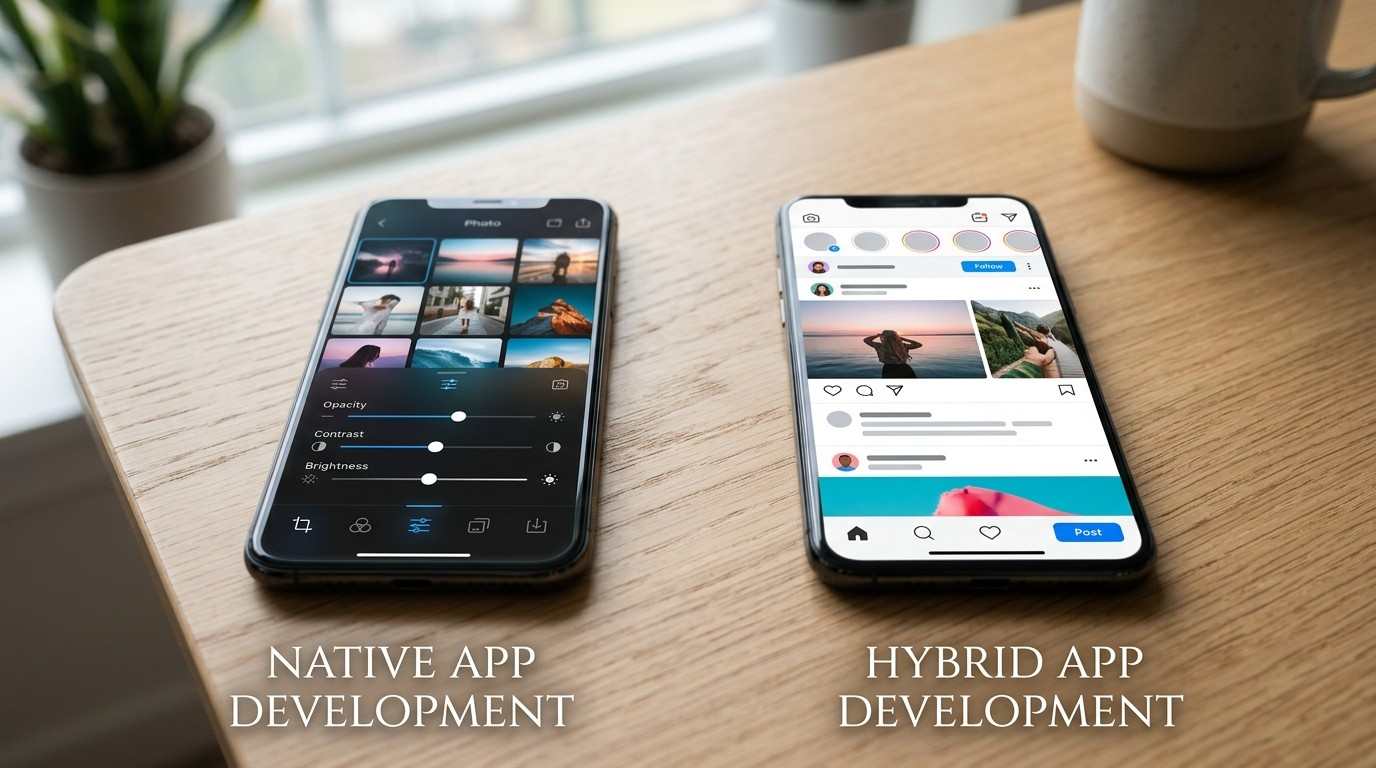
- Native vs Hybrid App Development: Which One Fits Your Business?
- What Is Native App Development?
- What Is Hybrid App Development?
- Native vs Hybrid: Head-to-Head Comparison Table
- Performance: Does Hybrid Really Lag Behind Native?
- Cross-Platform Development: Flutter vs React Native
- Cost & Timeline: What Startups and Small Businesses Should Know
- Limitations to Watch For
- How to Choose the Right Approach for Your Business
- FAQs – native vs hybrid app development
- Conclusion
Native vs Hybrid App Development: Which One Fits Your Business?
Every business planning a mobile app eventually hits the same fork in the road: native or hybrid. It’s one of the first big decisions you’ll make, and it shapes your budget, your timeline, and how your app performs once it’s in users’ hands.
The debate around native vs hybrid app development isn’t about which one is “better”; it’s about which one fits your business right now.
In this guide, we’ll break down how each approach works, compare them head-to-head on the things that actually matter, and help you land on the right call for your project.
What Is Native App Development?
Native app development means building your app specifically for one platform, iOS or Android, using that platform’s own language and tools.

Native apps are…
- typically built with Swift on iOS, while Android apps use Kotlin.
- Because the app is written directly for the platform, it gets full access to device hardware: camera, GPS, sensors, biometrics, all of it, with no middle layer slowing things down.
- This close-to-the-metal approach is also why native apps tend to feel so smooth. Animations run cleaner, navigation follows platform conventions users already know.
The trade-off is that “native” means building twice: once for iOS, once for Android, each with its own codebase, its own dev team skillset, and its own timeline.
Get Expert App Development Services
What Is Hybrid App Development?

Hybrid app development flips that trade-off.
Hybrid apps use..
- separate code for each platform; you build once using web technologies (HTML, CSS, JavaScript) wrapped inside a native shell that lets the app run on both iOS and Android.
- This single codebase app development approach means one team, one build process, and features that ship to both platforms at the same time.
- The appeal is speed and efficiency; you’re not duplicating effort across two teams.
- Hybrid mobile apps offer a practical middle ground between a native app and a basic mobile website.
Native vs Hybrid: Head-to-Head Comparison Table
| Factor | Native App | Hybrid App |
| Performance | Fastest: direct access to device hardware | Very good for most apps; slight lag in heavy graphics/animation |
| Development Cost | Higher: two separate builds (iOS + Android) | Lower: one codebase covers both platforms |
| Development Timeline | Longer: parallel builds or sequential releases | Shorter: build once, deploy twice |
| User Experience | Matches platform conventions exactly | Very close, minor differences in feel |
| Maintenance | Two codebases to update and test | One codebase, simpler long-term upkeep |
| App Store Approval | Standard approval process for each store | Same process, occasionally more scrutiny on performance |
| Best For | Complex, performance-heavy apps (gaming, AR, fintech) | MVPs, business apps, content-driven apps |
native means building the same app twice, while hybrid means building it once. That single difference cascades into cost, team size, and how fast you can get to launch, which is usually the deciding factor for native app development budget-conscious teams.
Book a Free Mobile Strategy Call
Performance: Does Hybrid Really Lag Behind Native?

The performance gap between native and hybrid is real, but it’s smaller than it used to be, and for most business apps, it doesn’t matter as much as people assume.
Modern hybrid frameworks have closed a lot of ground, so a typical app doing things like displaying content, handling forms, or making API calls will feel just as responsive as its native counterpart.
Where the gap still shows up is at the edges:
- apps with heavy animations
- complex 3D graphics
- real-time gaming
- intensive background processing.
In those cases, native’s direct hardware access gives it a real edge. So does a hybrid app perform as well as a native app?
For 90% of business use cases, yes, close enough that users won’t notice. For the remaining 10% of apps built around performance-intensive features, native is still the safer bet.
Not Sure Which App Fits Your Needs?
Get expert advice on the right performance level for your app.
Cross-Platform Development: Flutter vs React Native

If you land on hybrid, the next decision is which framework to build with, and it usually comes down to two options: Flutter or React Native.
Both fall under cross-platform web app development, and both let you write once and deploy to iOS and Android, but they take different approaches under the hood.
Flutter (built by Google)

- uses its own rendering engine;
- it draws every pixel on screen itself rather than relying on native UI components.
- Has a reputation for pixel-perfect consistency across platforms and strong performance on animation-heavy interfaces.
- It uses the Dart programming language, which has a smaller talent pool than JavaScript but a gentler learning curve for teams coming from Java or C#.
React Native (built by Meta)

- It renders actual native UI components rather than drawing its own,
- often makes apps feel closer to true native.
- React native app development also benefits from JavaScript’s massive developer pool.
- This means it’s usually easier to staff a team and find long-term support.
Choose Flutter if…
visual consistency and animation performance are top priorities
Choose React Native if…
you want a larger hiring pool and tighter integration with existing JavaScript/web teams
Both are mature, well-supported, and used in production by major companies.
This app development framework comparison ultimately comes down to your team’s existing skills and your app’s specific demands more than any inherent superiority of one framework over the other.
Explore Our Mobile App Portfolio
Cost & Timeline: What Startups and Small Businesses Should Know
For startups and small businesses, budget and speed to market often outweigh every other factor, and this is where the native vs hybrid decision has the clearest financial impact.
Native app development budget considerations start with the fact that you’re essentially funding two projects. Building for iOS and Android separately means two development teams (or one team working sequentially), two QA processes, and two sets of ongoing updates.
This typically pushes native development toward the higher end of the cost spectrum and makes it a bigger commitment for businesses still validating their product.
Hybrid flips this equation. Because you’re maintaining a single codebase, you cut development costs significantly, often close to half, depending on app complexity, since there’s no duplicated engineering effort.
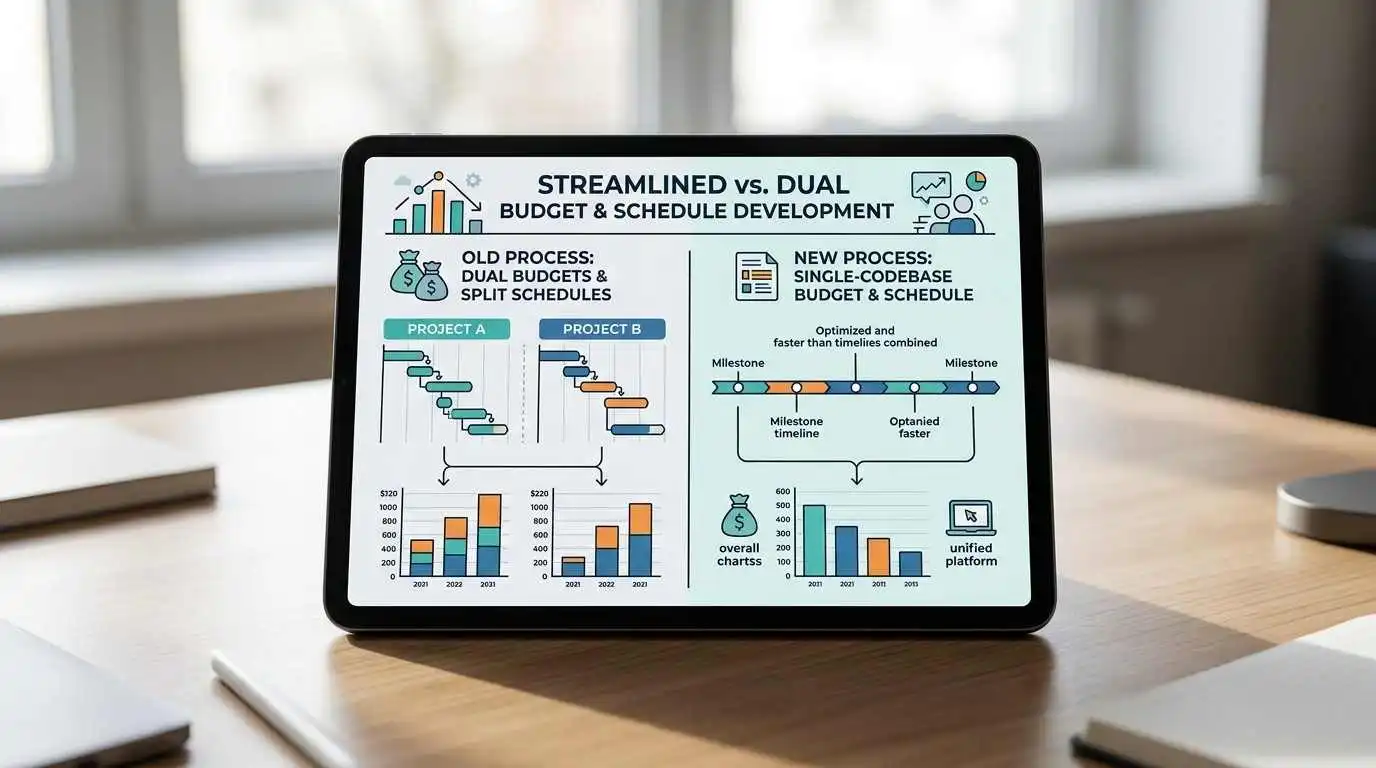
This is a major reason hybrid has become the default starting point for many MVPs.
Timeline follows the same logic.
Native development for app development for two platforms typically means a longer runway, whether teams work in parallel (higher cost, same timeline) or sequentially (lower cost, longer timeline).
Hybrid apps, by contrast, usually reach launch faster because there’s only one build to test, debug, and ship.
If you’re a startup validating an idea or a small business testing demand before a bigger investment, hybrid’s lower cost and faster timeline reduce risk.
If you’re a funded company building a flagship product where performance and platform-specific UX are core to the value proposition, native’s higher upfront cost often pays off long-term.
Limitations to Watch For
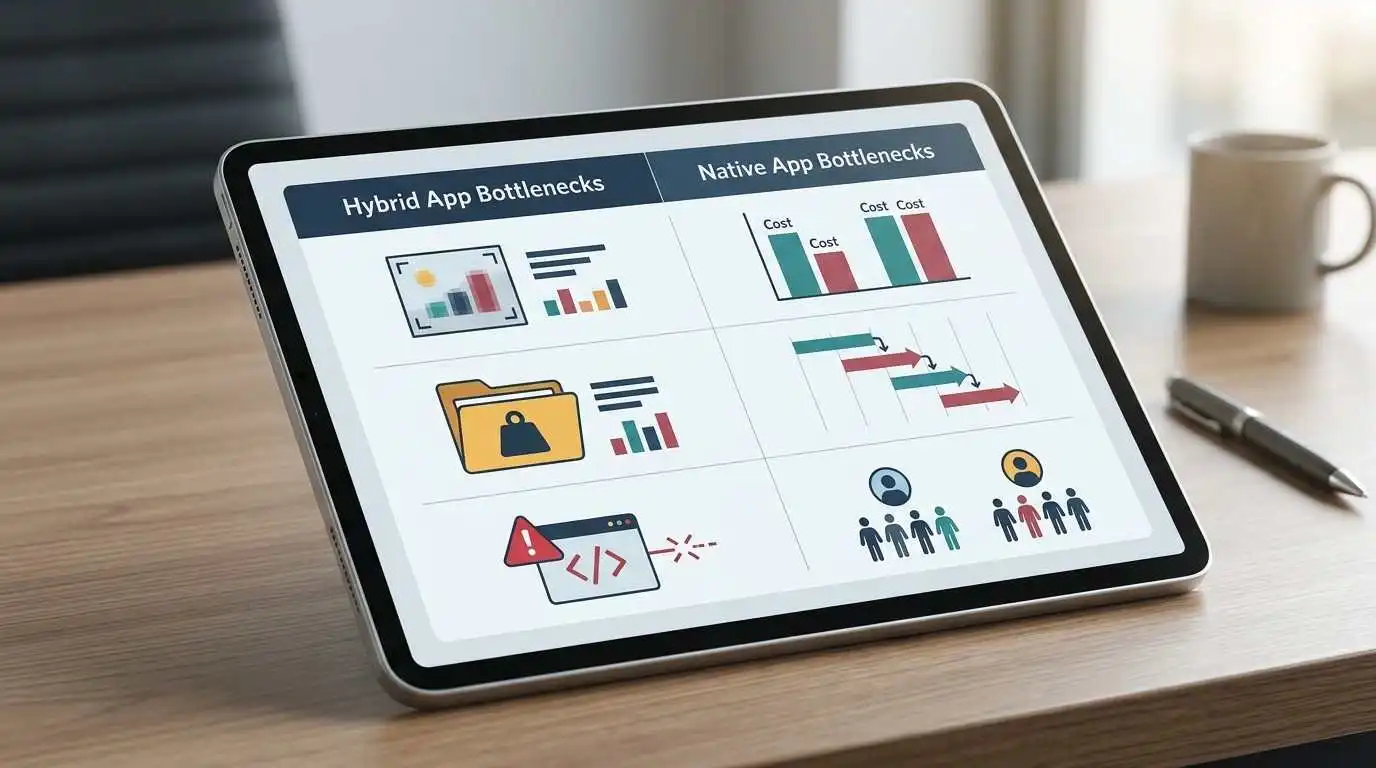
Hybrid app limitations
- Performance ceiling on graphics-heavy or animation-intensive features (gaming, AR/VR)
- Access to newer device features can lag behind native, since plugins need updating first
- Occasional visual inconsistencies between iOS and Android despite the shared codebase
- Larger app size compared to a true native build, in some cases
- Debugging can get trickier when an issue lives in the native wrapper layer, not the shared code
Native app limitations
- Higher development cost from maintaining two separate codebases
- Longer timeline for feature updates, since every change needs to be built and tested twice
- Requires two specialized teams (or one team fluent in both Swift/Kotlin), which can be harder to staff
- Slower to iterate; a quick fix on iOS doesn’t automatically carry over to Android
Hybrid’s limitations mostly show up in performance-heavy edge cases, while native’s limitations mostly show up in cost and speed.
Neither is a dealbreaker on its own; it depends purely on what trade-off your business can absorb.
Avoid Costly App Development Mistakes
Get a free consultation before committing to a development path.
How to Choose the Right Approach for Your Business

Choosing an app framework comes down to five practical questions:
-
What’s your budget?
If you’re working with limited funding or still validating your idea, hybrid’s lower cost gets you to market without a heavy upfront commitment. If you’ve got dedicated funding for a flagship product, native’s cost is easier to justify.
-
How soon do you need to launch?
Tight timeline, one platform build vs. two — hybrid wins on speed almost every time.
-
How complex is your app?
Simple to moderate complexity (content apps, booking apps, e-commerce, business tools) runs well on hybrid. Apps built around gaming, AR/VR, or heavy real-time processing lean native.
-
Which type of app is easier to maintain long term?
Generally, hybrid — one codebase means one place to push updates, fix bugs, and roll out new features. Native maintenance means duplicating that work across two platforms indefinitely.
-
What are your long-term plans?
If you’re planning to scale into a performance-heavy product down the line, some businesses start hybrid to validate, then rebuild native once the product-market fit is proven. Others go native from day one to avoid a rebuild later.
If you’re unsure, hybrid is usually the safer starting point — it’s lower risk, faster to launch, and easier to walk back or upgrade from than trying to retrofit a native app down to a smaller budget.
View Custom Web & Tech Solutions
FAQs – native vs hybrid app development
What is the real difference between native and hybrid apps?
Native apps are built separately for iOS and Android using platform-specific languages like Swift and Kotlin, giving them direct access to device hardware.
Hybrid apps use a single codebase across both platforms, trading a bit of performance for lower cost and faster development.
Which is faster to build, a native app or a hybrid app?
Hybrid apps are generally faster to build since there’s only one codebase to develop, test, and deploy.
Native apps take longer because iOS and Android versions are built and tested separately, whether in parallel or one after the other.
Does a hybrid app perform as well as a native app?
For most business apps, yes, the performance difference is barely noticeable to users. The gap only becomes significant in graphics-heavy or animation-intensive apps like games and AR experiences.
Is Flutter or React Native better for cross-platform apps?
Neither is universally better. Flutter suits teams prioritizing visual consistency and animation performance, while React Native suits teams that want a larger developer pool and a closer-to-native feel.
Which option is more cost-effective for a startup?
Hybrid is typically more cost-effective for startups, since a single codebase eliminates the need to fund two parallel development efforts. This makes it a common choice for MVPs and early-stage validation.
Can a hybrid app later be converted into a native app?
Yes, many businesses start with hybrid to validate their idea, then rebuild in native once they’ve confirmed product-market fit and need the extra performance. It’s a common and practical growth path.
Which type of app is easier to maintain long term?
Hybrid apps are generally easier to maintain since updates and bug fixes only need to happen once across a single codebase. Native apps require duplicating maintenance work across two separate codebases.
How do I decide which approach is right for my business?
Weigh your budget, timeline, app complexity, and long-term growth plans. If you’re still unsure, hybrid is usually the lower-risk starting point.
Build Your App With the Right Team
Let experts map out the ideal development path for your business.
Conclusion
There’s no universal winner in the native vs hybrid debate. The right choice depends on your budget, your timeline, and what your app actually needs to do.
Hybrid gets you to market faster and cheaper, which makes it a strong fit for startups, MVPs, and most business apps. Native earns its higher cost when performance and platform-specific experience are core to what you’re building.
If you’re still weighing the two, Top Branding Altimeter can help you assess your project’s needs and map out the right development path for your business.
Ready to Grow Your Business?
Get expert guidance tailored to your brand — completely free consultation
Get Free Consultation