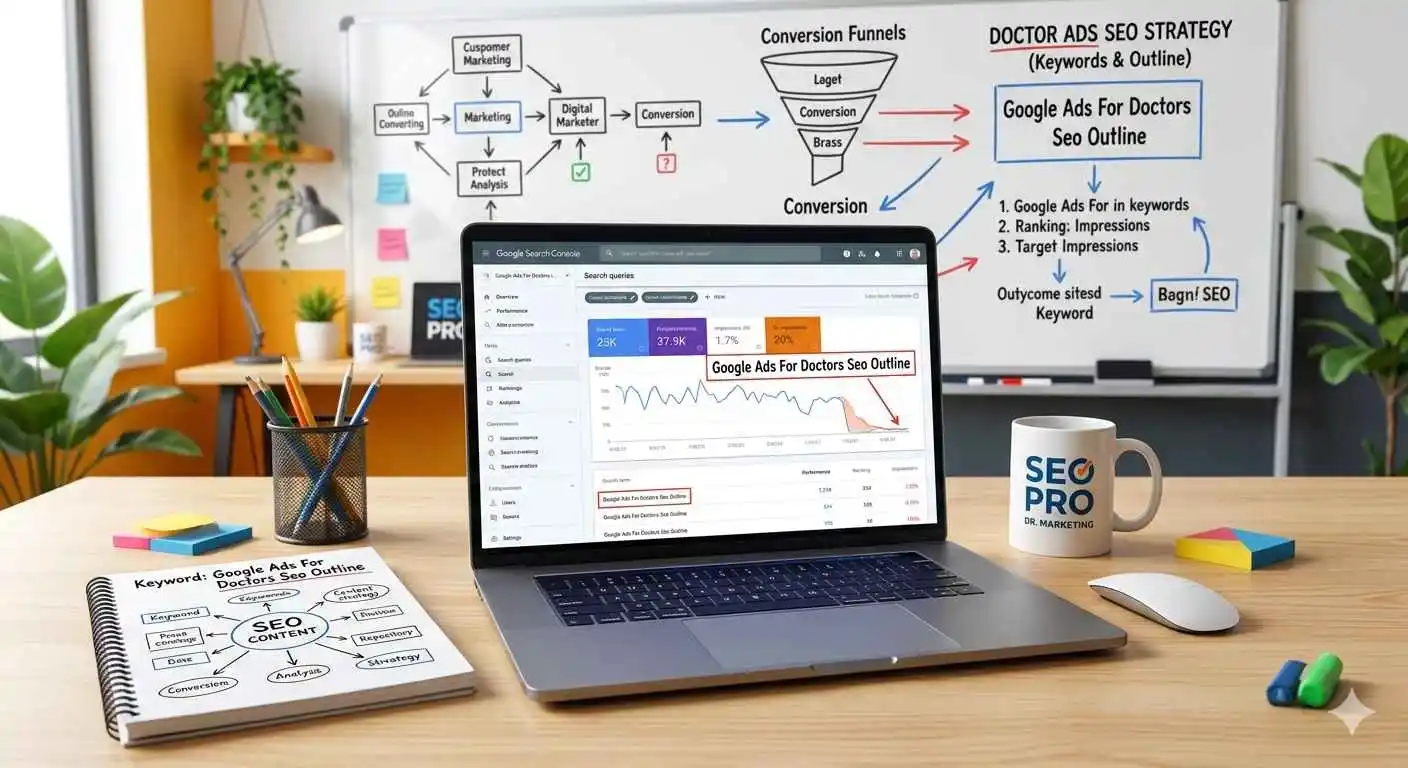
- Google Ads for Doctors SEO Outline: Complete 2026 Campaign Strategy Guide
- (1) – Why Doctors Need Google Ads
- (2) – How Google Ads Works for Medical Practices
- (3) – Google Ads Strategy for Doctors
- (4) – Keyword Research for Medical Ads
- (5) – Creating High-Converting Ads
- (6) – Landing Page Optimization for Doctors
- (7) – Budgeting & ROI for Google Ads
- (8) – Common Mistakes to Avoid
- (9) – Hiring a Google Ads Agency for Doctors
- (10) – Google Ads for Doctors: 2026 Updates You Must Know
- SEO-Friendly FAQs
Google Ads for Doctors SEO Outline: Complete 2026 Campaign Strategy Guide

If you are a doctor, clinic owner, dentist, or healthcare provider trying to grow your patient base in today’s competitive digital landscape, Google Ads for doctors SEO Outline is no longer optional — it is a critical pillar of your patient acquisition strategy. While organic SEO takes months to produce results, a well-structured Google Ads campaign puts your practice directly in front of high-intent patients searching for your services right now.
This complete guide walks you through everything — from campaign structure and keyword targeting to budget planning, landing page optimization, and ROI tracking. Whether you are running a private practice, a multi-location clinic, or a specialized medical office, this Google Ads strategy guide is built for you.
This guide has been updated for 2026 to include the latest Google Ads changes, AI-powered bidding strategies, and new healthcare ad policies that every doctor and clinic owner must know before launching a campaign.
(1) – Why Doctors Need Google Ads
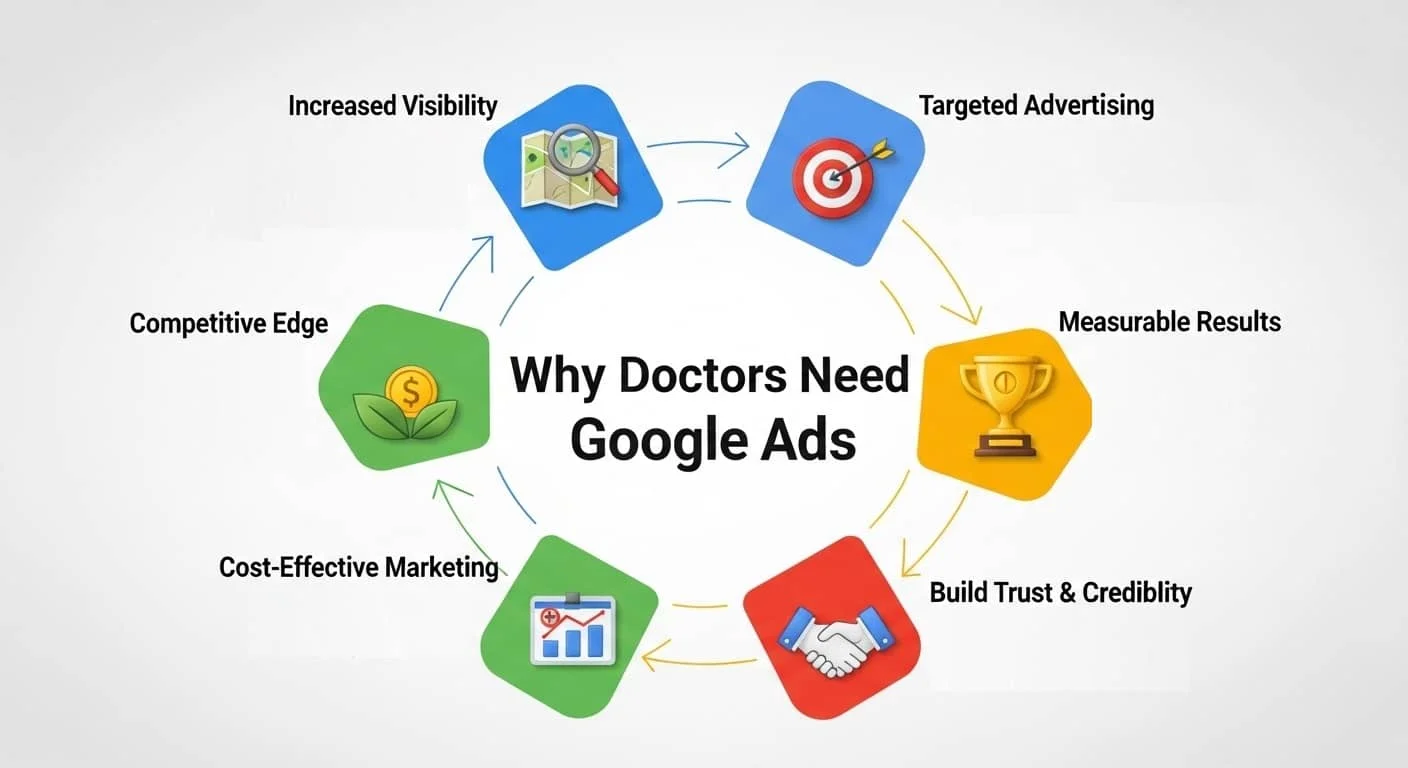
The way patients find healthcare providers has changed permanently. Over 77% of patients begin their healthcare journey with an online search. When someone types “urgent care near me” or “best cardiologist in [city],” they are ready to book. That is the exact moment your practice needs to appear — and Google Ads for clinics makes that possible with precision and speed that no other channel can match.
Patient Acquisition Challenges
Most private practices and clinics face the same core problems when trying to attract new patients:
- Organic SEO takes 6–12 months to show results, leaving a large patient acquisition gap in the short term.
- Word-of-mouth referrals are unpredictable and impossible to scale.
- Social media content rarely converts browsers into booked appointments.
- Competition from large hospital networks with bigger marketing budgets is intensifying.
- Healthcare-specific directories like Healthgrades and Zocdoc charge ongoing subscription fees without guaranteed ROI.
These challenges make paid ads for doctors one of the most effective tools available. With Google Ads, you appear at the top of search results immediately, you only pay when someone clicks, and you have full control over who sees your ads and when.
Benefits of PPC for Healthcare
PPC for healthcare providers delivers a set of advantages that no other marketing channel offers at the same speed and scale:
Immediate Visibility — Your ads go live within hours of campaign launch. You do not have to wait months to rank. From day one, your practice appears at the top of Google for the exact terms your potential patients are searching.
High-Intent Audience — People clicking on medical Google Ads are actively looking for a doctor right now. This is not passive audience awareness — it is a patient acquisition funnel built on real search intent.
Geo-Targeted Reach — Local targeting for clinics ensures your budget is spent reaching patients within your service area, not wasted on irrelevant traffic from other cities or states.
Measurable ROI — Every dollar you spend is tracked. You know exactly how many people saw your ad, clicked it, called your office, or booked an appointment. This level of transparency makes doctor marketing via Google Ads fully accountable.
Scalable Growth — As your campaigns mature and your conversion data accumulates, your Google Ads bidding strategy becomes more efficient. You spend less per patient acquisition over time while growing your volume.
(2) – How Google Ads Works for Medical Practices
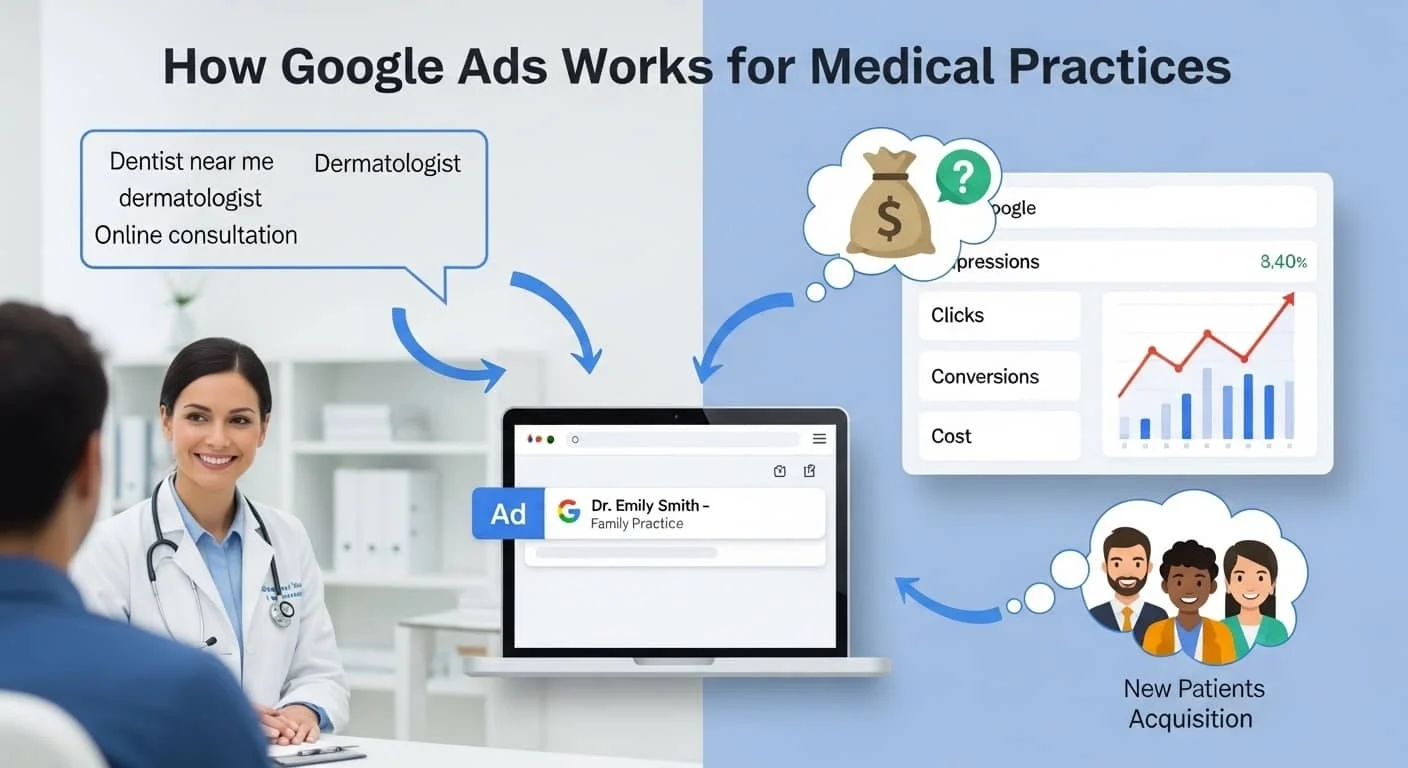
Understanding the mechanics behind medical practice advertising on Google is essential before investing your budget. Google Ads operates on an auction system — when a patient searches for a healthcare service, Google evaluates bids, ad quality, and landing page relevance to determine which ads appear and in what order.
Search Ads vs Display Ads
For most Google Ads for doctors campaigns, Search Ads are the highest-converting format and should be your primary investment.
Search Ads appear at the top of Google’s results page when patients search specific terms like “family doctor accepting new patients” or “dentist open on Saturday near me.” These ads are triggered by intent — the patient is already looking for what you offer.
Display Ads appear across Google’s partner website network — blogs, news sites, YouTube, and apps. They work better for brand awareness and remarketing to patients who have already visited your website but have not yet booked. Display is a supporting tactic, not a primary patient acquisition channel.
Local Services Ads (LSAs) are a newer format from Google specifically designed for healthcare providers. LSAs show your practice at the very top of the page with a “Google Screened” badge, your star rating, and phone number. They operate on a pay-per-lead model rather than pay-per-click, making them a strong complement to standard healthcare PPC campaigns.
For most medical practices, we recommend a combined strategy: Search Ads for high-intent acquisition, LSAs for local trust-building, and Display Remarketing for re-engaging warm prospects who have not yet converted.
Local Targeting for Clinics
Local targeting ads are one of the most powerful features of Google Ads for healthcare providers. Rather than paying to show your ad nationally, you can restrict your campaigns to:
- A specific city or ZIP code radius around your practice
- Multiple service areas if you operate more than one location
- Specific neighborhoods where your ideal patient demographic is concentrated
When combined with geo-targeting for healthcare ads, this ensures your cost per click (CPC) and overall budget are allocated only to patients who can realistically visit your office. A dentist in Phoenix, Arizona, has no business paying for clicks from patients in New York City. Local targeting eliminates that waste entirely.
You can also layer in audience targeting — for example, targeting users who have recently searched for health insurance, specific medical conditions, or competitor practices. This level of control is what makes healthcare digital marketing through Google Ads so powerful compared to traditional advertising.
(3) – Google Ads Strategy for Doctors
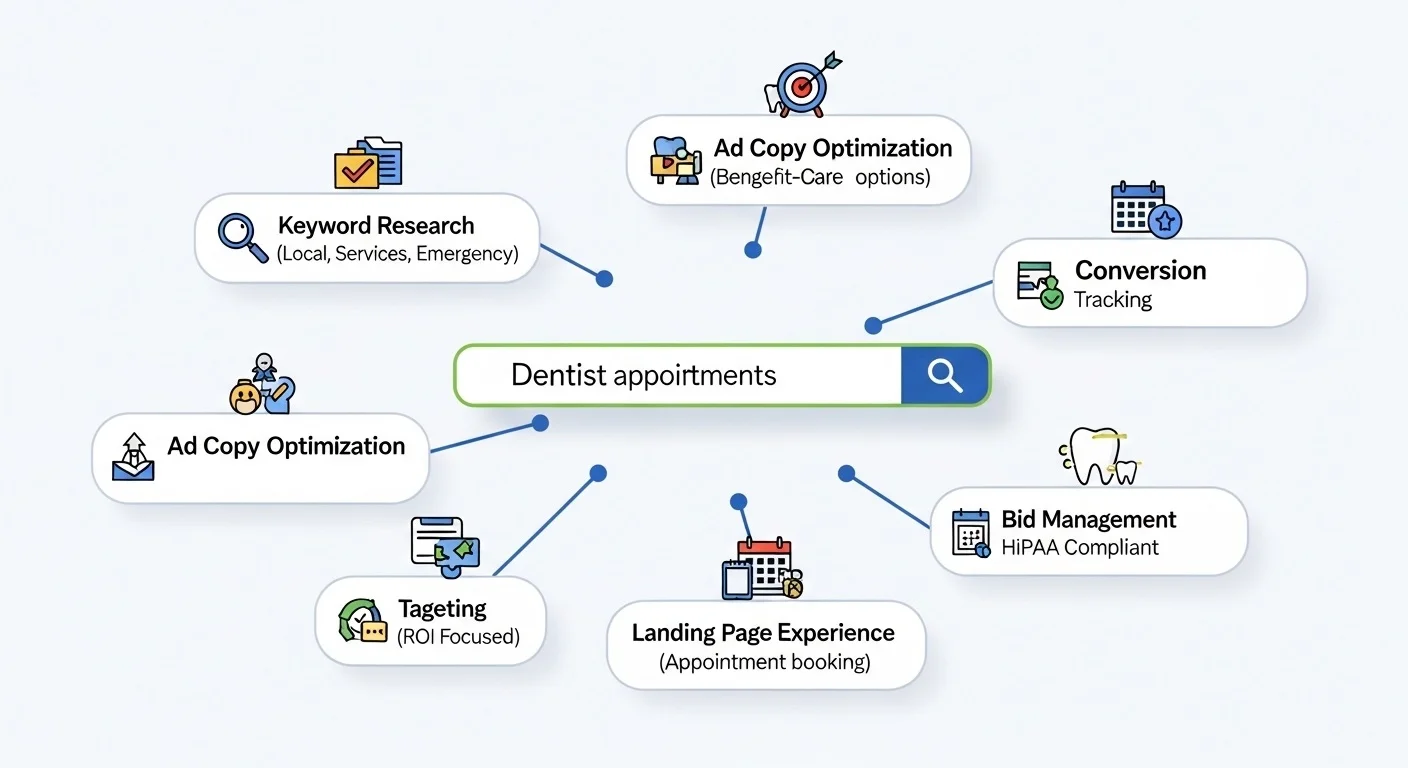
A successful Google Ads strategy for doctors is built on three pillars: the right campaign structure, precise keyword targeting, and intelligent audience segmentation. Most practices that run ads without a clear strategy end up overspending for poor results. The structure below is designed to maximize your quality score, minimize wasted spend, and build a sustainable patient conversion funnel.
Campaign Structure
A well-built PPC campaign structure for a medical practice typically looks like this:
Campaign Level — Organized by service or specialty. For example:
- Campaign 1: General Practice / Primary Care
- Campaign 2: Pediatrics
- Campaign 3: Urgent Care
- Campaign 4: Specialty Services (Cardiology, Orthopedics, etc.)
Separating campaigns by service type allows you to allocate budgets independently, track performance by specialty, and tailor messaging to each patient audience.
Ad Group Level — Within each campaign, ad groups are organized by specific patient needs or search intents. For example, within a Dentistry campaign: Ad Group 1: Teeth Whitening | Ad Group 2: Emergency Dental | Ad Group 3: Invisalign.
Ad Level — Each ad group contains 3–5 ad variations (Responsive Search Ads are recommended) tested against each other so Google can automatically serve the best-performing message.
This structure makes your ad campaign planning organized, scalable, and easy to optimize over time.
Keyword Targeting
Keyword targeting for doctors is the engine that drives your entire campaign. You need to identify the exact phrases your potential patients type into Google at the moment they are ready to seek care.
High-performing keyword categories for doctors include:
- Condition-based keywords: “back pain specialist near me,” “anxiety treatment doctor.”
- Service-based keywords: “same-day doctor appointment,” “walk-in clinic near me.”
- Specialty + location keywords: “cardiologist in [city],” “family doctor accepting new patients [ZIP code].”
- Competitor + comparison keywords: “alternative to [competitor name]” (use carefully)
Use a mix of broad match modifiers, phrase match, and exact match keywords depending on your budget and campaign maturity. Exact match gives you maximum control; phrase match provides a balance of reach and precision.
Audience Targeting
Beyond keyword targeting, Google Ads allows you to layer audience signals on top of your keyword strategy to reach the most qualified patients:
- In-Market Audiences: Users actively researching healthcare services
- Remarketing Lists: Patients who visited your website or landing page but did not book
- Similar Audiences: Users who share behavioral patterns with your existing patients
- Customer Match: Upload a list of past patients (HIPAA-compliant) to re-engage them with specific messages
This multi-layered approach to audience targeting dramatically improves your campaign’s efficiency and lowers your cost per lead over time.
(4) – Keyword Research for Medical Ads

Medical keywords for Google Ads require a different research approach than standard commercial keywords. Healthcare searches have strong emotional context and urgency — your keyword strategy must reflect that.
High Intent Keywords
High-intent patient keywords are those that signal a patient is ready to take action — not just researching. These keywords are the foundation of your patient acquisition strategy:
Examples of high-intent medical keywords:
- “Book an appointment with a cardiologist near me.”
- “urgent care open now [city].”
- “dentist accepting new patients [ZIP code].”
- “LASIK eye surgery consultation [city]”
- “mental health therapist near me accepting insurance.”
These keywords convert at significantly higher rates than informational queries like “what causes chest pain” which attract researchers, not patients who are ready to book. Focus your budget on appointment-booking intent, not content consumption intent.
Long-tail keywords (3–5 words) typically have a lower cost per click in healthcare while converting at higher rates because they represent more specific, urgent patient needs.
Negative Keywords
Your negative keyword strategy is equally important as your positive keyword list. Without it, your ads appear for irrelevant searches, wasting budget and distorting your performance data.
Common negative keywords for medical Google Ads campaigns include:
- free, cheap, cost, price (unless you offer free consultations)
- jobs, career, hiring, internship
- school, degree, course, certification
- self-treatment, DIY, home remedy
- veterinarian, animal, pet (for human medicine campaigns)
- Wikipedia, WebMD, research study (informational, not transactional intent)
Review your search term reports weekly in the early stages of your campaign and add irrelevant terms to your negative keyword list. This practice alone can reduce wasted spend by 20–40% while improving your quality score optimization.
(5) – Creating High-Converting Ads

Ad copy is where strategy meets persuasion. Even a technically perfect campaign will fail if your ads do not compel patients to click. Ad copy optimization for healthcare requires balancing clinical credibility with clear, action-driven messaging.
Ad Copy Tips
The best-performing Google Ads for doctors follow these proven copy principles:
Lead with the patient’s problem — Your headline should immediately mirror what the patient typed. If they searched “knee pain specialist near me,” your headline should read: Knee Pain Specialist Near You – Same-Week Appointments Available.
Include trust signals in your copy — Years in practice, board certifications, number of patients treated, insurance acceptance, and patient satisfaction ratings all belong in your ad text. These signals reduce hesitation and increase click-through rates.
Communicate urgency and availability — “Accepting New Patients Now,” “Same-Day Appointments Available,” and “Open Evenings & Weekends” are consistently high-performing phrases in medical ad copy because they remove friction from the decision to call.
Localize your copy — Mention the city or neighborhood. “Top-Rated Family Doctor in Austin, TX” outperforms a generic “Find a Family Doctor Today” because it confirms to the patient that you are nearby and relevant.
Write at least 3 headline variations and 2 description variations per Responsive Search Ad (RSA). Google’s algorithm tests combinations and weights the best performers automatically — but only if you give it enough variation to work with.
CTA for Doctors
The call-to-action (CTA) in your medical ads must be specific, not generic. “Learn More” is weak. “Book Your Appointment Today” is strong. Here are proven CTAs for doctors:
- Book Your Free Consultation Today
- Schedule Your Appointment Online Now
- Call Us – Same-Day Availability
- Request Your New Patient Appointment
- Check Our Availability – Book in 60 Seconds
Your CTA should align precisely with what happens when the patient clicks the ad. If your CTA says “Book Online Now” but your landing page has no online booking system, you will lose conversions at the most critical moment in the funnel.
Ad Extensions
Ad extensions are free add-ons that expand your ad’s size and visibility on the search results page. For paid advertising in healthcare, the most valuable extensions are:
- Call Extensions: Displays your phone number directly in the ad. This single extension can generate a large percentage of your total patient leads, especially on mobile.
- Location Extensions: Shows your practice address and a map link. Essential for local patient acquisition.
- Sitelink Extensions: Additional links to specific pages — “Meet Our Doctors,” “Insurance We Accept,” “Book Online,” “Patient Reviews.”
- Callout Extensions: Short phrases like “Board Certified Physicians,” “Accepting New Patients,” “Telehealth Available,” “Bilingual Staff.”
- Structured Snippets: List your specialties — Cardiology, Family Medicine, Pediatrics, Women’s Health.
Using all available ad extensions improves your ad’s Quality Score, which directly reduces your cost per click and improves your ad position.
(6) – Landing Page Optimization for Doctors
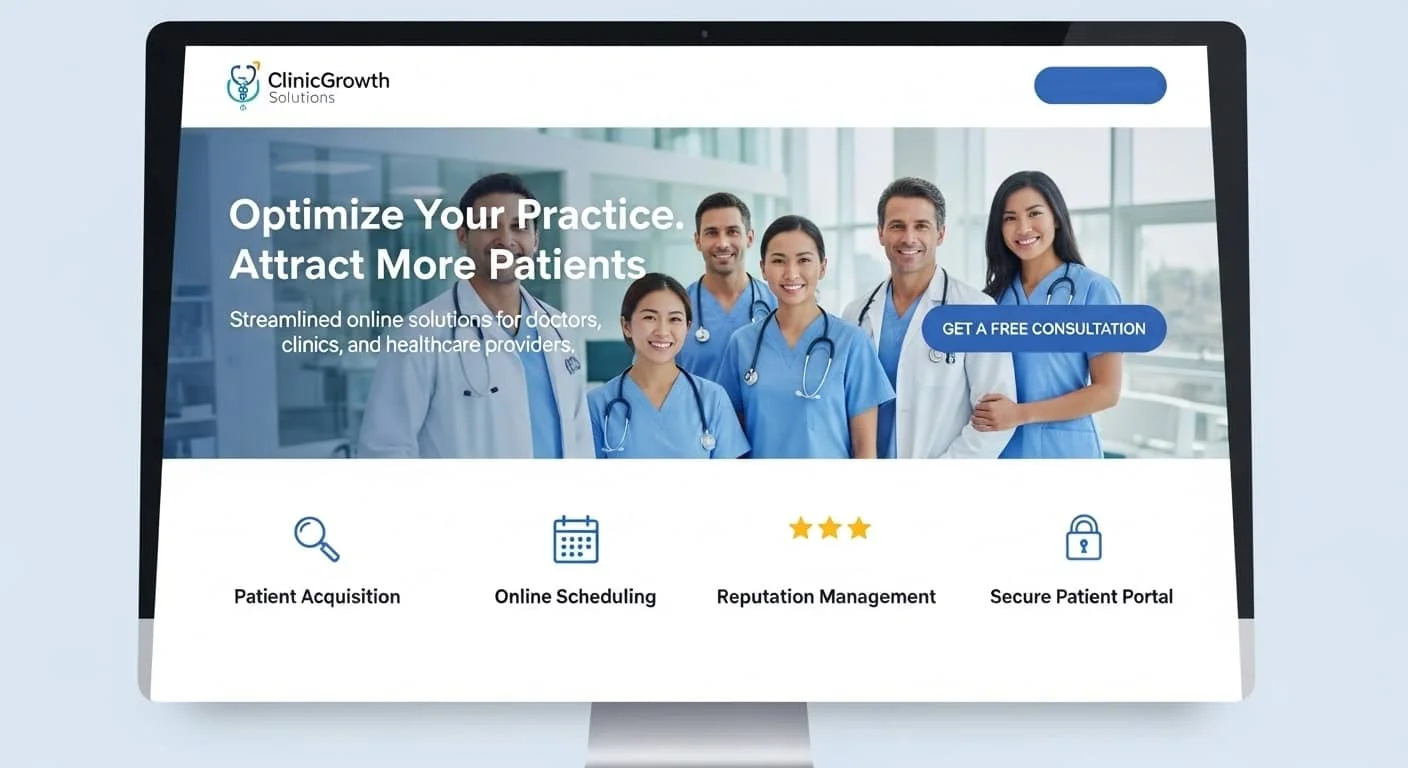
Your ad is the invitation — your landing page is where the conversion happens. A healthcare landing page that is not optimized for conversion will waste every dollar you spend on the ad itself. Landing page optimization is the highest-leverage activity in your entire Google Ads system.
Appointment Booking Optimization
The single most important goal of any medical landing page is to get the patient to book an appointment. Your appointment booking funnel must eliminate every possible barrier:
- Place a prominent booking form or “Book Now” button above the fold — visible without scrolling
- Keep the booking form short: Name, Phone Number, Preferred Service, Preferred Date. Every additional field reduces form completions.
- Offer multiple contact options: online form, phone call, and live chat
- Confirm availability clearly — “We Have Appointments This Week” reassures patients immediately
- Display your office hours prominently so patients know they can call right now
- Use a confirmation message or thank-you page that sets expectations: “We’ll contact you within 2 hours to confirm your appointment.”
Integrate your booking form with your practice management software (Epic, Kareo, Athenahealth, or similar) so leads flow directly into your scheduling system without manual data entry.
Mobile Optimization
Over 70% of healthcare searches occur on mobile devices. If your landing page is not fully optimized for mobile, you are losing the majority of your potential patients before they even read your offer. Mobile optimization for clinics requires:
- Page load time under 3 seconds on mobile (use Google PageSpeed Insights to test)
- Large, thumb-friendly buttons for clicking and form submission
- Click-to-call phone numbers so patients can call directly without typing
- Single-column layout for easy scrolling on small screens
- Minimal text blocks — use short paragraphs, bullet points, and visual breaks
- Readable font sizes (minimum 16px for body text)
- No intrusive popups that obscure content on mobile
Google’s algorithm factors mobile experience directly into your Quality Score — meaning poor mobile performance not only hurts your conversion rate but also raises your cost per click.
Trust Signals
Patients choosing a healthcare provider are making one of the most personal and high-stakes decisions they will ever make. Your landing page must aggressively communicate trust:
- Doctor Bio & Photo: A professional headshot and brief biography humanize your practice and build immediate rapport
- Patient Reviews & Ratings: Display Google Reviews, Healthgrades ratings, or verified testimonials with real patient names (with consent and HIPAA compliance)
- Credentials & Certifications: Board certifications, medical school affiliations, years of experience, and hospital privileges
- Insurance Information: A clear list of accepted insurance providers reduces a major friction point
- Privacy Assurance: A brief statement about how patient information is handled — critical for HIPAA compliance in marketing
- Award or Media Mentions: “Voted Best Doctor in [City] 2026,” “Featured in [Local Publication]”
Trust signals are not decoration — they are conversion infrastructure. The more credibility your landing page communicates, the lower your cost per patient lead becomes.
(7) – Budgeting & ROI for Google Ads
One of the most common questions from healthcare providers is: “How much do Google Ads cost for doctors?” The honest answer is: it depends — but the framework below gives you everything you need to plan intelligently.
Cost Per Click
Cost per click in healthcare is among the highest of any industry because of the competitive, high-value nature of patient acquisition. Here are realistic national average CPCs for medical specialties in the USA:
| Medical Specialty | Average CPC (USA) | Competition Level |
|---|---|---|
| General Practice / Family Medicine | $3 – $8 per click | Medium |
| Dentistry | $4 – $12 per click | High |
| Plastic Surgery / Cosmetic Procedures | $8 – $25 per click | Very High |
| Mental Health / Therapy | $3 – $10 per click | Medium |
| Urgent Care | $5 – $15 per click | High |
| Cardiology / Orthopedics | $6 – $20 per click | High |
| Physical Therapy (2026 New) | $4 – $10 per click | Medium |
| Telehealth Services (2026 New) | $5 – $18 per click | Very High |
Note: CPCs in major metro areas (New York, Los Angeles, Chicago) typically run 30–50% higher than these national averages.
Budget Planning
PPC budgeting for healthcare starts with a reverse-engineering approach:
- Set a patient acquisition target — How many new patients per month do you want from paid ads?
- Estimate your conversion rate — A well-optimized campaign typically converts 5–15% of clicks into appointments
- Calculate required clicks — If you need 20 new patients per month at a 10% conversion rate, you need approximately 200 clicks per month
- Multiply by your estimated CPC — 200 clicks × $8 CPC = $1,600/month budget
For most small-to-mid-sized medical practices in the USA, a starting Google Ads budget of $1,500 – $5,000/month is appropriate. This provides enough data to optimize effectively without overexposing the budget before the campaign is proven. As campaigns mature and CPA (cost per acquisition) decreases, budgets can be scaled confidently.
ROI Tracking
ROI tracking for Google Ads in healthcare requires proper conversion tracking setup from day one. Without tracking, you are flying blind. The minimum conversion actions you must track are:
- Phone calls from ads (via call tracking numbers — Google’s native call tracking or a third-party solution)
- Form submissions (appointment request forms, contact forms)
- Online booking completions (if using an integrated scheduling system)
- Live chat conversations (if applicable)
Once you have clean conversion data, calculate your cost per lead for medical campaigns: Total Ad Spend ÷ Total Conversions = Cost Per Lead (CPL). Compare your CPL to your average lifetime patient value (LPV). If your average patient generates $2,000 in lifetime revenue and your CPL is $120, your Google Ads ROI is exceptional and your campaign deserves more budget.
(8) – Common Mistakes to Avoid
Even well-intentioned healthcare PPC campaigns fail when these common mistakes go uncorrected:
Sending All Traffic to Your Homepage — Your homepage is designed for general navigation, not conversion. Every campaign needs a dedicated landing page built around one specific offer and one conversion action.
Ignoring Negative Keywords — Without a robust negative keyword list, your budget leaks into irrelevant searches. This is one of the most expensive mistakes in paid advertising for healthcare.
Poor Quality Score Management — A low Quality Score increases your CPC and lowers your ad position. Quality Score is determined by expected click-through rate, ad relevance, and landing page experience. All three must be actively managed.
No Conversion Tracking — Running campaigns without tracking is like operating a business without a cash register. You cannot optimize what you cannot measure.
Broad Match Keyword Abuse — Using broad match keywords without negative keywords blows your budget on completely irrelevant traffic. Start with phrase and exact match, then layer in broad match as you accumulate negative keyword data.
Violating Google’s Healthcare Ad Policies — Google has strict policies around medical advertising. Certain claims, language, and targeting methods are restricted or prohibited. Violating these policies results in ad disapprovals or account suspension.
Neglecting Mobile Experience — As mentioned, 70%+ of your clicks come from mobile. A poor mobile landing page experience is conversion suicide.
Set-It-and-Forget-It Management — Google Ads is not a passive channel. Campaigns require weekly optimization, bid adjustments, keyword additions, negative keyword updates, and A/B testing to improve over time.
(9) – Hiring a Google Ads Agency for Doctors
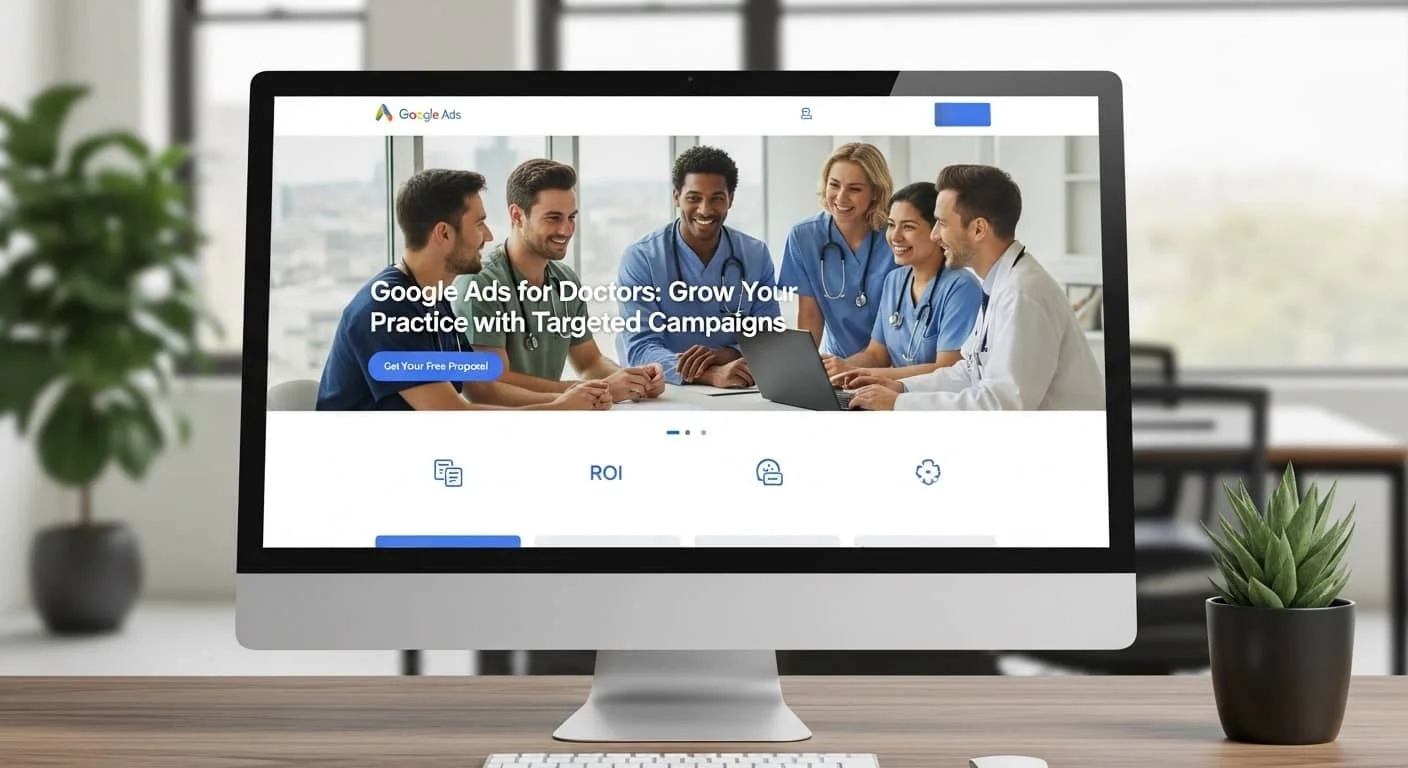
Managing a high-performance Google Ads strategy for doctors requires deep platform expertise, healthcare marketing knowledge, continuous optimization, and a substantial time investment. For most doctors and clinic owners, self-managing Google Ads while running a practice is not realistic.
Partnering with a Google Ads agency for clinics that specializes in healthcare PPC delivers measurable advantages:
- Faster Results: Experienced agencies eliminate the learning curve and costly trial-and-error phase
- Advanced Campaign Structures: Professional PPC management services deploy sophisticated campaign architectures that generic agencies or in-house staff rarely build correctly
- Compliance Knowledge: Healthcare advertising involves complex restrictions around HIPAA, FDA guidelines, and Google’s healthcare policies. Specialists navigate these guardrails without disrupting campaign performance
- Continuous Optimization: Dedicated account managers monitor and improve campaigns daily, not monthly
- Transparent Reporting: Professional agencies provide clear ROI tracking dashboards so you always know exactly what your investment is producing
When evaluating agencies, ask specifically about their healthcare PPC experience, their process for HIPAA compliance in marketing, and their conversion tracking methodology. Ask for case studies from medical or dental clients. An agency that cannot show you real patient lead results from real healthcare clients is not the right choice.
Top Branding Altimeter is a full-service Digital Marketing Agency that delivers specialized Google Ads management for doctors, lead generation for doctors, and complete healthcare digital marketing solutions across the USA. Our team combines deep paid media expertise with healthcare industry knowledge to build campaigns that generate real patients, not just clicks.
If you are ready to grow your practice with a team that understands both digital marketing and healthcare, explore our full suite of services at Top Branding Altimeter.
For practices in the Midwest, we also operate as a leading PPC Agency Wisconsin — delivering locally grounded healthcare advertising strategies with national-level execution.
(10) – Google Ads for Doctors: 2026 Updates You Must Know
The Google Ads landscape for healthcare providers has changed significantly in 2026. Here is what every doctor and clinic owner must know before launching or updating their campaign.
AI-Powered Smart Bidding Is Now the Standard
Google has fully shifted toward AI-driven bidding in 2026. Manual CPC bidding is still available but increasingly disadvantaged. For medical practices, the recommended bidding strategies are now:
Maximize Conversions with a Target CPA — Ideal for appointment booking campaigns where you have defined a clear cost-per-patient target. Target ROAS — Best for practices tracking lifetime patient value and wanting Google’s AI to optimize toward revenue, not just clicks. Enhanced CPC (eCPC) — A transitional strategy for practices not yet ready for full automated bidding.
The key change: AI bidding now requires a minimum of 30–50 conversions per month to work effectively. If your campaign volume is below this threshold, focus on manual CPC with careful bid adjustments until you accumulate sufficient conversion data.
Performance Max Campaigns for Doctors
Google’s Performance Max (PMax) campaign type is now available and recommended for healthcare advertisers in 2026. PMax runs across all Google channels — Search, Display, YouTube, Gmail, and Maps — from a single campaign.
For doctors and clinics, PMax is particularly effective for:
- Local patient acquisition across Google Maps and Search simultaneously
- Remarketing to website visitors across YouTube and Display
- Reaching new patient audiences Google’s AI identifies as similar to your existing converters
Important: PMax requires strong creative assets — headlines, descriptions, images, and videos. Practices without video content will underperform in PMax. Start with standard Search campaigns first if you do not have video assets ready.
2026 Google Healthcare Ad Policy Updates
Google updated its sensitive health categories advertising policies in 2026. Key changes affecting doctors and clinics:
Personalized advertising restrictions now apply to more health condition categories. Ads that target users based on specific health conditions (diabetes, mental health, oncology) face tighter restrictions. Verification requirements for certain healthcare specialties have expanded. Practices advertising addiction treatment, telehealth, and fertility services may require additional Google verification steps. LegitScript certification is now strongly recommended (and in some specialties, required) for healthcare advertisers to maintain ad approval rates.
Action required: Review your current ad targeting settings to ensure you are not using health condition-based audience targeting in ways that violate updated policies. When in doubt, use keyword intent targeting rather than audience health condition targeting.
Local Services Ads Expansion for Healthcare
In 2026, Google expanded Local Services Ads (LSAs) to additional medical specialties including mental health providers, physical therapists, and several specialty medicine categories.
If your specialty is now eligible for LSAs, add them immediately. LSAs appear above standard Search Ads and operate on a pay-per-lead model — you only pay when a verified patient contacts your practice. This makes them one of the most cost-efficient patient acquisition tools available in 2026.
SEO-Friendly FAQs
How much do Google Ads cost for doctors?
The average cost per click for healthcare Google Ads in the USA ranges from $3 to $25, depending on your specialty, location, and competition level. Most practices need a monthly budget of $1,500 to $5,000 to generate meaningful patient volume. Highly competitive specialties like plastic surgery or cosmetic dentistry in major metro areas may require budgets of $5,000 to $15,000 per month.
Are Google Ads effective for medical practices?
Yes — when properly structured and managed, Google Ads for medical practices are one of the highest-ROI digital marketing investments available. They deliver immediate visibility to high-intent patients, fully measurable results, and scalable growth. Practices with well-optimized campaigns consistently achieve cost-per-patient-lead figures far below the lifetime value of a new patient.
What keywords should doctors target?
Doctors should prioritize high-intent patient keywords that signal appointment readiness: specialty + location phrases (“cardiologist in [city]”), service + urgency phrases (“same-day doctor appointment near me”), and condition + action phrases (“knee pain treatment [city]”). Avoid over-investing in broad informational keywords that attract researchers rather than patients ready to book.
How do doctors get patients through Google Ads?
Doctors attract patients through Google Ads by appearing at the top of search results when those patients are actively looking for care. The process is: targeted keyword strategy → compelling ad → dedicated landing page with appointment booking → conversion tracking → continuous optimization. The patient acquisition strategy improves over time as data accumulates and campaigns are refined.
What is the ROI of Google Ads for clinics?
ROI tracking for Google Ads in healthcare depends on your specialty and average patient lifetime value (LPV). A general practitioner with an LPV of $1,500 and a CPL of $100 achieves a 15:1 ROI ratio. Specialty practices with higher LPVs can achieve even greater returns. Proper conversion tracking is essential to calculate and improve your ROI accurately.
Do Google Ads require a landing page?
Technically, no — you can send traffic to your homepage. But in practice, dedicated healthcare landing pages dramatically outperform homepages for conversion. A homepage is designed for general navigation; a landing page is designed for one specific action: booking an appointment. Using your homepage for ad traffic is one of the most common and costly mistakes in medical practice advertising.
Can doctors run ads without a website?
Google’s Local Services Ads (LSAs) do not require a traditional website — just a Google Business Profile. However, standard Search Ads require a destination URL. For doctors without a website, this is a significant limitation. A professional healthcare website with a dedicated landing page is strongly recommended before investing in any paid advertising. Building one should be your first step — Top Branding Altimeter provides healthcare-focused web design built for conversion.
What is the best ad strategy for doctors?
The best Google Ads strategy for doctors combines Search Ads targeting high-intent local keywords, Local Services Ads for trust and visibility, and Display Remarketing for re-engaging website visitors. This three-tier approach covers immediate patient acquisition, brand credibility, and long-term nurturing within a single, cohesive healthcare ad funnel.
What is new in Google Ads for doctors in 2026?
The biggest changes for healthcare Google Ads in 2026 include the expansion of AI-powered Smart Bidding, the availability of Performance Max campaigns for medical practices, updated healthcare advertising policies around sensitive health categories, and the expansion of Local Services Ads to additional medical specialties. Practices that adapt their campaigns to these 2026 updates gain a significant competitive advantage in patient acquisition.
How long does it take to see results?
Initial results — clicks, impressions, and first patient inquiries — typically appear within the first 1–2 weeks of a well-structured campaign launch. Meaningful optimization data accumulates within 30–60 days. By month 3, campaigns should be producing consistent, cost-efficient patient leads. Full campaign maturity, where your cost per acquisition reaches its optimal baseline, typically occurs between months 3 and 6 of continuous management and optimization.
Ready to Grow Your Business?
Get expert guidance tailored to your brand — completely free consultation
Get Free Consultation